Digital Twin vs BIM: What Differs, What Overlaps, and What Owners Need
Digital twin vs BIM clarified for owners and AEC teams: definitions, data needs, Scan to BIM foundations, LOD, QA/QC, and when each approach creates real value.
BimzstudioMar 9, 202614 min
digital twinBIMScan to BIMfacility managementLODas-built
Digital Twin vs BIM: A Practical Guide for Building Owners and Project Teams
“We need a digital twin” has become a common project request. So has “we need BIM.” The problem is that the two phrases are often used interchangeably—even though they describe different capabilities, different data demands, and different operating costs. Teams that blur the distinction either overbuy technology they cannot maintain or under-deliver a twin that is really just a static model with a new label.
This article separates digital twin vs BIM in practical terms: what each is, where they overlap, why confusion persists, how EU and U.S. owners are applying both, and how Scan to BIM, LOD, and QA/QC create the geometric foundation any serious twin requires.
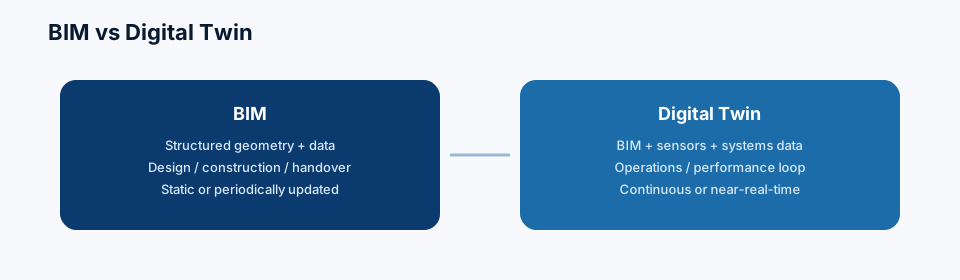
BIM is structured information; a twin adds operational feedback.
BIM (Building Information Modeling) is a collaborative process and a structured digital representation of a facility’s physical and functional characteristics. In project delivery, BIM typically supports design coordination, quantity extraction, clash detection, and construction sequencing. An as-built BIM model captures the facility as constructed or as surveyed.
A digital twin is a living digital counterpart of a physical asset that maintains a useful connection to operational reality over time. That connection may include sensor feeds, work-order systems, inspection records, energy data, or scheduled updates from reality capture. Geometry alone does not make a twin. Continuity of information and decision feedback does.
The market problem looks like this:
Owners request a “digital twin” but only budget for a one-time Revit model.
Vendors sell dashboards disconnected from reliable as-built geometry.
Facility teams inherit models too heavy, too generic, or too inaccurate for operations.
Project BIM and operations twins are procured separately, so naming, assets, and coordinates never align.
Nobody owns the update process after handover.
When the physical building changes—retrofits, tenant improvements, equipment replacements—the digital representation drifts. Without a maintenance plan, both BIM and twin investments decay into expensive archives.
Understanding digital twin vs BIM is therefore less about marketing vocabulary and more about matching capability to decision needs: design/construction coordination versus continuous operational insight.
Why It Happens
Language inflation
Technology markets reward ambitious words. “BIM” expanded from modeling to a broad delivery method. “Digital twin” expanded from manufacturing and aerospace into every building dashboard. Sales decks often present twins as the inevitable next step after BIM, skipping the hard parts: data quality, integration, governance, and cost of staying current.
Different buyers inside the same organization
Capital projects teams buy BIM for design and construction. Facilities and energy teams buy monitoring platforms. IT buys integration middleware. If these groups do not share an information strategy, the organization accumulates parallel “sources of truth.”
As-built quality is underestimated
Many twins assume the underlying model is correct. In existing buildings, design models are not as-builts. Without Scan to BIM and QA/QC against point clouds, room counts, shaft locations, and equipment clearances can be wrong before the first sensor is connected.
Unclear performance questions
A twin without a decision use case becomes a visualization project. Useful twins answer questions such as:
Which assets are due for maintenance in this wing?
Where is energy intensity drifting from baseline?
Can this retrofit fit in the existing plant room?
What is the current status of life-safety systems after a renovation?
If nobody defines those questions, teams build features instead of outcomes.
Lifecycle handoff failure
Even excellent project BIM can die at handover: wrong formats, missing asset IDs, no FM parameter mapping, no responsibility for updates. The twin conversation then restarts from scratch years later.
Industry Examples (EU / USA)
European Union
EU owners—especially in public estates, transportation, and large corporate campuses—often approach digital twins through information management and sustainability lenses:
Public asset portfolios seek standardized information containers and clearer handover under ISO 19650-aligned practices.
Industrial and manufacturing facilities in Germany and the Nordics connect production and building systems, where geometric accuracy around process equipment is critical.
Smart district initiatives combine building models with energy and occupancy data, but mature programs still rely on verified as-builts for retrofit planning.
Heritage and civic estates use twins selectively: environmental monitoring linked to conservation models rather than full enterprise twin platforms.
European conversations frequently emphasize open data exchange, long-term stewardship, and carbon/energy performance—not only construction clash metrics.
United States
U.S. practice is often driven by owner-operators with strong facilities organizations:
Healthcare systems explore twins for asset management, compliance documentation, and renovation coordination in live hospitals.
Airports and transit agencies combine geospatial systems, BIM, and operations data for complex, continuously changing assets.
Corporate real estate uses BIM for projects and separate IWMS/CAFM platforms for operations; twin initiatives attempt to bridge them.
Higher education campuses pilot twins for energy optimization and space management, with mixed results when base geometry is outdated.
In both regions, the programs that endure start with reliable geometry and clear operational ownership. The ones that stall start with a software demo and an incomplete model.
Technical Explanation
Twins need reliable sensors, IDs, and update governance — not only geometry.
BIM in technical terms
A BIM model contains objects with geometry and attributes in a shared coordinate context. During design and construction, federated models support clash detection, 4D/5D planning, and coordinated deliverables. After construction—or after Scan to BIM for existing assets—the model can become an as-built record.
Key BIM characteristics:
Structured elements (walls, ducts, equipment)
Defined LOD / Level of Information need
Discipline authorship and coordination workflows
Exchange via native formats and IFC
Strong value in project delivery and retrofit design
Digital twin in technical terms
A digital twin adds continuity:
Connection to the physical asset through data streams or update protocols
State that changes as the asset changes
Use in operational decisions, prediction, or optimization
Governance for identity, security, and data quality over time
A twin may include BIM geometry, but it can also include GIS, point clouds, meshes, asset databases, BAS/BMS tags, CMMS work orders, and IoT telemetry. Geometry is one layer—not the whole system.
Where they overlap
Capability
BIM
Digital twin
Coordinated design model
Core
Often inherited
Clash detection / construction coordination
Core
Indirect (via project BIM)
As-built documentation
Common
Foundational input
Live sensor integration
Rare
Common goal
Continuous FM decision support
Limited unless maintained
Core intent
Predictive maintenance
Not inherent
Possible with data + process
One-time project delivery
Strong fit
Incomplete if stop here
The Scan to BIM foundation
For existing buildings, digital twin ambition collapses without trustworthy spatial data. Scan to BIM provides:
Reality capture via laser scanning / controlled photogrammetry
Registered point clouds in a known coordinate system
Skipping this foundation creates a twin that is digitally sophisticated and spatially wrong.
LOD and information need for twins
Twins do not automatically require LOD 500 everywhere. In fact, over-detailed geometry can harm performance. A practical pattern:
Navigation and space management: solid LOD 200–300 architecture
MEP-critical plant rooms: higher detail where clearances and maintainability matter
Assets: reliable IDs and locations, not necessarily fabrication-level geometry for every diffuser
Analytics layers: linked data, not duplicated geometry
Define Level of Information Need for operations separately from design LOD.
Best Practices
Handover BIM quality is the foundation of any twin roadmap.
Name the decision first. Write the operational questions the twin must answer before selecting a platform.
Treat BIM as necessary but not sufficient. Project BIM is a starting point; twinning requires update protocols and integrations.
Invest in as-built truth. Use Scan to BIM and QA/QC for existing assets before connecting live data.
Right-size geometry. Model what operations and retrofit teams need; link the rest.
Create a single asset identity strategy. Equipment IDs must survive from design to CMMS to dashboards.
Assign an owner. A twin without a responsible steward becomes stale within one renovation cycle.
Plan cybersecurity and access. Operational twins touch building systems and sensitive data.
Stage the roadmap. Phase 1: verified as-built BIM. Phase 2: asset linking. Phase 3: selected live data. Phase 4: analytics.
Budget for change. Tenant improvements and capital projects must include model update scopes.
Measure value. Track avoided field conflicts, faster renovation design, energy savings, or maintenance response improvements.
Step-by-Step Solution
Step 1: Separate the vocabularies in the project charter
State explicitly whether the near-term deliverable is:
Design/construction BIM
As-built BIM
FM-ready BIM
Operational digital twin
Avoid using “digital twin” as a synonym for “3D model.”
Step 2: Define use cases and success metrics
Examples:
Reduce renovation survey time by X%
Link 100% of critical assets to CMMS locations
Provide verified clearances for plant replacements
Detect energy anomalies by wing within 24 hours
Step 3: Audit existing data
Inventory drawings, prior BIM, point clouds, BMS points, and asset lists. Identify gaps and contradictions.
Step 4: Capture and verify geometry (existing assets)
Execute laser scanning, registration, Scan to BIM modeling, and deviation-based QA/QC. Align to a durable coordinate system.
Step 5: Structure information for operations
Agree parameters, classification (e.g., Uniclass/OmniClass where used), naming, and spaces/zones. Keep the model performant.
Step 6: Integrate only what the use case needs
Connect CMMS, BMS, or IoT in controlled pilots. Validate tag mapping and location accuracy.
Step 7: Establish update governance
Every renovation or major maintenance event should trigger a defined model/twin update pathway—who updates, in what format, by when, with what QA.
Step 8: Scale carefully
Expand from one building or one system (e.g., HVAC critical assets) to portfolio level only after proving operational ownership.
Case Study
Asset: Mid-size manufacturing campus with mixed-age buildings (EU industrial context) Initial request: “Build a digital twin for energy and maintenance optimization.”
What the team found:
Existing design models for newer halls did not match field conditions in utility corridors.
Older halls had paper archives only.
A BMS was active, but point names did not consistently match asset tags.
What they did instead of jumping to a full twin platform:
Scoped a verified as-built BIM program using Scan to BIM for utility-critical zones and primary architecture.
Defined LOD 300 for most architecture/structure and higher detail in mechanical rooms.
Ran QA/QC deviation checks before any integration work.
Linked critical assets to the CMMS with a cleaned identity scheme.
Piloted energy dashboards on one production hall using validated spatial zones.
Result: The owner deferred a portfolio-wide “twin” marketing purchase and first built a trustworthy geometric and asset foundation. Within a year, renovation design time dropped because teams stopped re-surveying the same corridors, and maintenance routing improved because asset locations were reliable. The twin roadmap continued—but on top of BIM truth, not instead of it.
Common Mistakes
Calling any 3D model a digital twin. Static models are not twins.
Connecting live data to wrong geometry. Beautiful analytics on incorrect rooms mislead operators.
Over-modeling for FM. Fabrication-level ducts everywhere can make models unusable for facilities teams.
No update contract. If renovations do not update the model, drift is inevitable.
Platform-first procurement. Software selection before use-case and data-quality planning.
Ignoring Scan to BIM QA/QC. Assumed accuracy is not accuracy.
Fragmented IDs. Three naming systems across BIM, BMS, and CMMS guarantee integration pain.
All-at-once portfolio rollouts. Twins fail fast when governance is immature.
Expert Tips
Use “as-built BIM + update plan” as the minimum twin prerequisite. If that is not funded, you are not ready.
Write a digital twin vs BIM RACI. Clarify who owns project models versus operational systems.
Keep point clouds as long-term evidence. Even after modeling, registered clouds support future audits and renovations.
Prefer shallow, reliable integrations over deep, fragile ones. A few trustworthy data links beat dozens of brittle connectors.
Design for renovation reality. Most commercial buildings change continuously; twins must assume change.
Separate visualization from system of record. Executive dashboards can be pretty; the system of record must be governed.
Ask vendors where geometry comes from. If the answer is vague, accuracy risk is high.
Align LOD matrices to twin phases. Do not let design LOD automatically become operations LOD.
Future Trends
Operational twins with selective fidelity: More owners will model critical systems deeply and keep lighter context elsewhere.
Automated change detection: Comparing new scans to prior twins to flag renovations and unauthorized changes.
AI copilots on verified data: Useful only when underlying BIM/twin data is trustworthy.
Stronger ISO-aligned information management: Clearer requirements for lifecycle data across EU public work and sophisticated U.S. owners.
Reality capture as a service cadence: Periodic scanning campaigns instead of one-time as-built events.
Convergence of GIS + BIM + IoT: Especially for campuses, airports, and industrial sites—still dependent on coordinates and identity discipline.
The future is not “BIM dies and twins replace it.” The future is BIM as the structured spatial backbone and twins as the operational layer that remains alive.
FAQ
1. Is a digital twin just BIM with sensors?
No. Sensors can feed a twin, but a twin also requires identity management, update processes, and operational use. BIM with a few dashboards attached is not automatically a twin.
2. Do I need a digital twin if I already have BIM?
Only if you have continuous operational decisions that justify the cost of integration and upkeep. Many owners get enormous value from maintained as-built BIM without a full twin program.
3. Can Scan to BIM create a digital twin by itself?
Scan to BIM creates a verified geometric and informational foundation. It becomes twin-capable when linked to ongoing data and governed updates. Alone, it is as-built BIM—which is still highly valuable.
4. What LOD is required for a building digital twin?
It depends on use cases. Space management may need less geometric detail than mechanical replacement planning. Define information need by decision type rather than copying construction LOD everywhere.
5. Which comes first in existing buildings: twin platform or as-built model?
As-built model and data cleanup first. Platforms amplify whatever quality you feed them—good or bad.
6. How do EU and U.S. owners differ on digital twin vs BIM?
Emphasis differs—EU programs often stress information standards and energy/policy goals; U.S. programs often stress facilities operations and capital project throughput—but both fail without reliable as-builts and ownership models.
7. What is the biggest predictor of twin failure?
Lack of stewardship after handover, closely followed by inaccurate base geometry.
8. How should contracts distinguish BIM and twin deliverables?
Specify geometry LOD, information requirements, integration scope, update frequency, QA/QC acceptance tests, and who maintains the system for a defined period. Do not accept “digital twin” as a single undefined line item.
Summary
Digital twin vs BIM is not a rivalry—it is a layering problem. BIM provides structured, coordinated representation of a facility and is essential for design, construction, and retrofit. A digital twin extends that representation into continuous operational relevance through data connections and governance. Confusing the two leads to over-promised platforms on under-verified models.
For existing assets, Scan to BIM with explicit LOD and QA/QC is the practical starting point. From there, owners can add asset links and selective live data as use cases mature. European and U.S. organizations that succeed treat twins as managed products, not one-time project deliverables.
Build the Right Foundation with Bimzstudio
Whether you need coordination-ready as-built BIM or a geometry foundation for a future digital twin, Bimzstudio delivers Scan to BIM with clear LOD definitions and QA/QC against point cloud reality. We help EU and U.S. teams avoid “twin theater” by verifying existing conditions first—then structuring models so design, construction, and facilities stakeholders can actually use them.
If you are scoping a twin roadmap or an as-built BIM program, share your asset type and intended decisions. We will help you separate must-have BIM deliverables from later twin phases with a practical, accuracy-first plan.