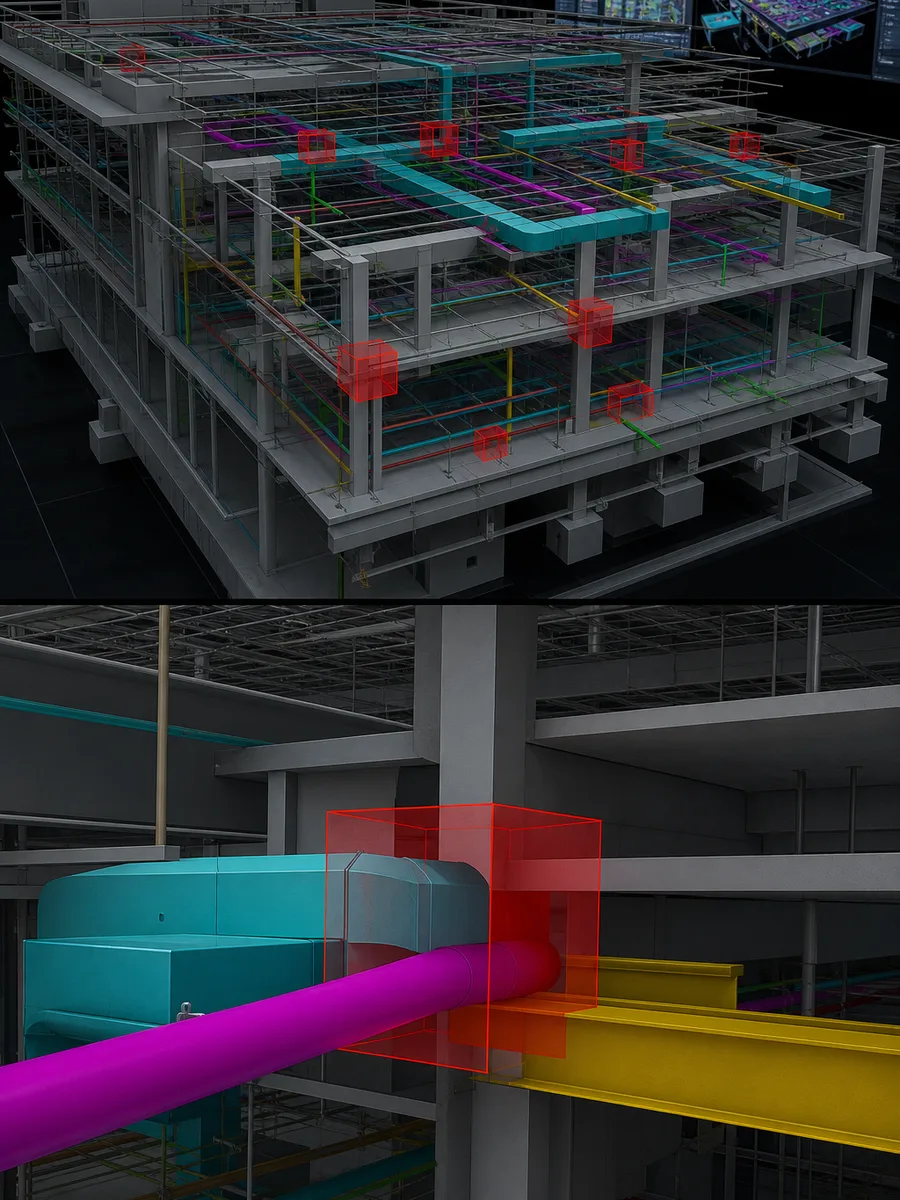
Why Bimzstudio Is Your Trusted Scan to BIM Partner: A Practical Evaluation Guide
A practical, evidence-oriented guide to evaluating Scan to BIM partners—and how Bimzstudio approaches accuracy, QA, communication, and delivery discipline.
BimzstudioJul 29, 202613 min
Scan to BIM partnerBimzstudioScan to BIM QAexisting conditions BIMpoint cloud modelingBIM vendor evaluation
Why Bimzstudio Is Your Trusted Scan to BIM Partner: A Practical Evaluation Guide
Choosing a Scan to BIM partner is an engineering procurement decision, not a branding exercise. You are selecting the team that will turn measured reality into models your designers, contractors, and facility managers will rely on for coordination, fabrication interfaces, and renovation decisions. If that model is visually impressive but poorly controlled, your project inherits silent risk.
This article is written as a partner evaluation guide. It explains what “trusted” should mean in Scan to BIM practice, which evidence to request from any vendor, and how Bimzstudio structures delivery to meet those criteria. It avoids inflated promises. Where outcomes depend on client inputs—scan quality, scope clarity, decision speed—those dependencies are stated plainly.
Trust is built on measurable QA, not marketing LOD claims.
Scan to BIM sits between survey science and BIM production. Buyers often evaluate only one side: either the cheapest modeling rate or the most polished portfolio images. Neither predicts whether the model will hold up under clash detection, IFC validation, or field verification.
Trustworthy Scan to BIM partners are defined by behaviors you can audit:
Coordinate honesty: models inherit and preserve survey control; origins are documented.
Scope discipline: inclusion/exclusion lists are explicit; surprises are change-managed.
Measurable QA: residuals at checkpoints, not “looks aligned.”
Software reality: files open in the agreed Revit (or other) version with usable worksets/linking strategy.
Communication under ambiguity: when cloud and drawings conflict, questions are raised early with options—not silently guessed.
Security hygiene: facility data is handled under agreed access controls.
Bimzstudio positions itself as a delivery partner around these audit points. The claim worth making is not perfection; it is process transparency and engineering accountability.
Why It Happens (Why Buyers Get Burned)
1. Portfolio bias. Attractive 3D views hide missing tolerances and empty parameters.
These failure modes are common across markets. A trusted partner designs the engagement to make them visible early—when correction is still cheap.
Industry Examples (EU/USA)
European Union
EU clients frequently evaluate Scan to BIM vendors through an information-management lens: Can you work inside our CDE? Can you align to ISO 19650-style exchange requirements? Can you deliver IFC with agreed properties? Heritage, healthcare, rail, and public building work also add confidentiality and documentation expectations.
In that environment, trust looks like:
Clear Level of Information Need responses
Documented CRS and registration dependencies
Sample IFC validation before mass export
Traceable revisions suitable for public-project audit trails
Bimzstudio’s approach for EU-aligned work emphasizes requirement mirroring: we do not invent a parallel standard; we translate your EIR/AIR extracts into a modeling and QA matrix you can review.
United States
US buyers—GCs, architects, industrial owners, healthcare systems—often prioritize schedule fit, Revit interoperability, and coordination readiness. Trade partners may consume models quickly for clash and prefabrication planning.
Trust in US contexts often looks like:
Fast, structured pilots on the hardest zone (not the empty lobby)
Explicit pipe/duct size cutoffs
ACC/CDE participation with controlled permissions
Residual checkpoints that a superintendent can understand
Practical sheet sets when design teams still work drawing-first
Across both regions, the evaluation pattern is the same: evidence over adjectives.
Technical Explanation: What Bimzstudio Optimizes For
A Scan to BIM model cannot exceed the reliability of its registered cloud and control. Bimzstudio engagements typically begin by reviewing:
Registration reports / control residuals (if available)
CRS and units
Coverage gaps and noise conditions
Client templates, naming, and LOD/LOI intent
Downstream use (design coordination, FM, fabrication interfaces)
If inputs are insufficient for the stated tolerance, we say so and propose options: rescan priorities, reduced scope, or tolerance adjustments. That conversation is part of trust.
2) Purpose-built LOD—not maximum geometry
We model to the inclusion matrix. Over-modeling wastes budget and can reduce clarity. Under-modeling without disclosure creates field risk. The professional act is alignment between purpose and content.
3) Coordinate and revision lineage
Deliverables should state:
Project CRS / shared coordinate method
Cloud revision used
Model revision
Software version
Known exceptions
This is how disputes get resolved later without archaeology.
4) QA that can be repeated
A practical QA package may include:
Checkpoint residual table (feature vs cloud)
Visual section evidence at agreed locations
Model health notes (warnings themes, link strategy)
Completeness check against the matrix
Optional IFC sample validation when required
Clients should be able to re-check selected points independently.
5) Communication protocol
Ambiguities are logged as questions with due dates. Silent assumptions are treated as defects waiting to happen. Weekly zone status beats vague “percentage complete.”
6) Dual deliverables when needed
Native RVT (or agreed authoring format) for editable use; IFC/exchange files when the client’s federation or archive requires them—with mapping discussed before the final week.
What trust looks like in day-to-day production
Trust accumulates in small operational behaviors. Meeting notes include decisions, not only attendees. Zone trackers show accepted, rejected, and blocked statuses with reasons. Question logs distinguish waiting-on-client from waiting-on-vendor. QA sheets cite checkpoint IDs that a third party could re-measure. When a deadline is at risk, the conversation happens early with options—reduce scope, add capture, extend time—not a surprise incomplete drop on the due date.
Bimzstudio treats those behaviors as part of the service, because Scan to BIM quality is inseparable from project management quality. A geometrically careful model delivered into the wrong coordinate system is still a failure. A complete model of the wrong inclusion matrix is still a failure. Process discipline prevents both.
Evidence pack clients should expect
Without claiming outcomes you cannot verify on your site, you can still demand an evidence pack pattern:
Pilot model in your template and software version
Checkpoint residual table for the pilot
Section images at agreed locations
Written exceptions and exclusions
Coordinate and cloud revision statement
Short known-issues list
Communication SLA confirmation
Bimzstudio engagements are structured to produce this kind of pack at pilot stage so you can accept or correct standards before scale.
Boundaries we will not blur
A trusted partner declines certain requests. We will not invent unscanned critical geometry and present it as measured. We will not pretend LOD slogans replace inclusion matrices. We will not guarantee zero field conflicts, because design changes, installation tolerances, and capture gaps exist in the real world. We will state assumptions in writing. Those refusals are features of trust, not lack of customer service.
Working beside your surveyor and your designers
Many projects already have a survey partner. Bimzstudio can model from provided registered clouds and will flag control or coverage concerns rather than silently absorbing them. When designers need iterative updates after new captures, revision lineage keeps everyone honest about which cloud underpins which model. The partner role is to integrate into your ecosystem—not to replace your professional team with a black box.
Best Practices for Partner Selection
Partners earn trust when models survive coordination and field checks.
Use this checklist for Bimzstudio or any competitor:
Ask for a redacted QA residual sheet from a prior job.
Require a paid pilot on a complex zone.
Score communication quality during bidding (questions asked, risks flagged).
Verify software versions and CDE fluency.
Review inclusion/exclusion examples in writing.
Confirm security handling for your facility type.
Ensure acceptance tests are contractual.
Avoid pure hourly races without scope caps or matrices.
Meet the people who will actually model, not only sales.
Check how change orders are priced before you need one.
Bimzstudio expects serious clients to run this checklist. Partners who fear sample scrutiny are signaling process risk.
Step-by-Step: How Bimzstudio Typically Delivers
Step 1: Discovery and use-case framing
Clarify why the model exists—renovation design, clash baseline, FM spaces, industrial tie-ins, heritage documentation—and what decisions it must support.
Step 2: Input audit
Assess clouds, control, drawings, templates, and gaps. Document constraints.
Step 3: Scope matrix and proposal
Produce inclusion/exclusion, tolerances, deliverables, assumptions, and schedule. Price against clarity.
Step 4: Pilot / sample zone
Model the agreed hard zone. Submit with QA evidence. Incorporate client comments into the production standard.
Step 5: Production in controlled packages
Deliver by building/level/zone with revision IDs. Maintain a question log.
Step 6: Client acceptance gates
Zones move from submitted → in review → accepted/rejected with reasons. Rejection patterns feed process fixes.
Step 7: Federation support
Help your team link models correctly; adjust worksets/splits if coordination needs demand it.
Step 8: Exchange exports (if in scope)
IFC or other formats tested against your checker rules where provided.
Step 9: Final compilation
Index of files, revisions, QA summaries, known issues, and coordinate statements.
Step 10: Closeout hygiene
Access revocation, data return/retention per contract, and lessons for multi-building programs.
This sequence is intentionally unglamorous. Reliability usually is.
How to run a fair pilot with Bimzstudio
Pick a zone that includes the hardest geometry you care about—plant room, dense corridor, heritage stair, or industrial rack—not a simple lobby. Provide template, CRS, and inclusion draft. Agree residual checkpoints in advance. Time-box questions. Accept or reject with written comments. If accepted, freeze that standard for production. If rejected, decide whether to iterate once or stop. Pilots exist to reduce risk for both parties.
Collaboration model options
Engagements may be fixed-scope packages, multi-building programs with unit rates, or staged discovery-plus-production when clouds are uncertain. Choose the model that matches input maturity. Uncertainty favors staged approaches. Clear matrices favor fixed packages. Bimzstudio will typically recommend the structure that matches your input reality rather than the structure that merely sounds simplest in a purchase order.
What clients bring to a successful partnership
Even strong vendors fail when clients cannot answer RFIs, change templates weekly without versioning, or withhold scan limitations. Partnership is bilateral. Allocate a reviewer, protect decision SLAs, and treat existing-conditions BIM as engineering, not commodity printing. The trusted outcome is co-produced.
Long-term program value
Owners and campus programs gain most when standards stabilize: same matrix language, same QA sheet, same coordinate policy, same deliverable index. Bimzstudio can support that standardization so Building 12 does not reinvent Building 1's arguments. Trust grows when lessons compound.
Case Study Style Scenario
Context (composite of common engagement patterns): A design team preparing a brownfield renovation receives mobile and static scans of a mid-rise building with dense basement MEP. Prior vendor models “looked complete” but failed early clash cycles; ducts appeared where the cloud was sparse, and coordinates drifted relative to site control.
Engagement approach with Bimzstudio:
Input audit identified weak coverage behind major AHUs and an undocumented local origin in the previous model.
Scope was rewritten around reliable zones first; unscanned cavities were listed as exclusions pending capture—not modeled as confident solids.
A pilot of the basement corridor and one plant room was delivered with checkpoint residuals and section evidence.
After acceptance, production continued level by level with weekly gates.
Questions on conflicts between archived drawings and cloud geometry were logged with recommended modeling rules (cloud governs unless client directs otherwise).
Deliverables included native models aligned to the client template, a registered-cloud revision reference, and a QA pack.
Observed project effects (typical when this discipline is followed):
Clash reviews shifted from arguing about model trust to resolving true design conflicts.
Designers stopped redrawing existing conditions from scratch in the accepted zones.
Change related to “missing existing elements” became traceable to either accepted exclusions or new capture needs—not mysterious modeling gaps.
This scenario is not a guarantee of identical results on every site. It illustrates the causal chain Bimzstudio optimizes: honest inputs → explicit scope → pilot evidence → gated production → usable coordination baselines.
Common Mistakes When Buying Scan to BIM
Awarding all buildings before accepting one pilot.
Treating marketing renders as technical submittals.
Hiding scan defects hoping the modeler will “make it work.”
Demanding aggressive deadlines without reviewer availability.
Skipping CRS discussion.
Asking for FM-ready data without providing the field list.
Accepting files you have not opened in your production environment.
Using one vendor’s silent assumptions as your office standard without documentation.
Assuming the lowest unit rate includes unlimited revisions.
Leaving vendor access active after handover.
Expert Tips
Put acceptance metrics in the PO, not only in email.
Choose the pilot zone that scares you; easy pilots teach nothing.
Require the vendor to state what they will not model.
Keep a client-side owner for decisions within 24–48 hours during production ramps.
For industrial work, align tie-in isometrics and cloud tiles explicitly.
For heritage work, agree simplification rules for irregular geometry before modeling artistry expands scope.
If you need both RVT and IFC, fund mapping and a mid-project export test.
Evaluate Bimzstudio (and others) on how they behave when the cloud is imperfect—that is the real partnership test.
Future Trends
Scan to BIM is moving toward hybrid pipelines: automated classification and feature extraction, human QA, and continuous reality capture updates. Trusted partners will be those who can integrate automation without abandoning residual accountability.
Owners will demand stronger cybersecurity and clearer data residency answers. OpenBIM validation will expand in EU public work; US coordination will stay native-heavy but increasingly archive open formats. Partners who only sell “fast modeling” will struggle; partners who sell controlled information products will remain relevant.
Bimzstudio’s direction aligns with that shift: better tooling where it helps, unchanged insistence on measurable QA and scope honesty.
Comparing proposals beyond unit price
When comparing Bimzstudio to other vendors, normalize scope first. Ask each bidder to price the same matrix, same pilot zone, and same QA sheet. Then compare residual methods, CDE approach, security terms, and staffing plan. A lower unit price that excludes residuals, sheets, or coordinate setup is not cheaper—it is incomplete. Demand apples-to-apples registers.
Red flags in any Scan to BIM proposal
Promises of full-facility LOD detail with no exclusions; refusal to pilot; no mention of CRS; guaranteed clash-free construction; AI that replaces QA; and delivery dates incompatible with cloud size and reviewer capacity. Treat these as risk signals. Bimzstudio proposals aim to make assumptions visible so you can manage them.
FAQ
What makes Bimzstudio different from a generic CAD outsourcing shop?
Focus on Scan to BIM as measured existing-conditions production: coordinates, residuals, inclusion matrices, and coordination-ready files—not only drawing recreation.
Do you capture laser scans?
Engagements vary. Some clients provide clouds from their surveyors; others need help coordinating capture requirements. Model reliability still depends on capture quality either way.
Can you match our Revit template and standards?
Yes—when templates and standards are provided up front and included in the pilot acceptance cycle.
How do you handle incomplete scans?
By documenting gaps, proposing options (rescan, exclude, or reduced confidence modeling), and refusing to silently invent critical geometry.
Do you guarantee zero field clashes?
No responsible Scan to BIM provider can guarantee that. We aim to provide a verified existing-conditions baseline within agreed tolerances so coordination addresses real conflicts.
What should we send to start?
Sample cloud (or viewer access), CRS info, target software version, purpose of the model, any template, and a draft inclusion list or prior spec.
How is pricing structured?
Typically around clarified scope—pilot plus zone packages or unit matrices—rather than undefined hourly promises. Complex ambiguity may start with a paid discovery/pilot.
Evaluation Scorecard Template
Score each vendor 1–5 on: pilot residual transparency, coordinate documentation, inclusion matrix clarity, communication during bid, CDE/security readiness, schedule realism, relevant sector experience, and price normalized to identical scope. Weight residuals and matrix clarity highest for Scan to BIM. Bimzstudio welcomes being scored this way because it mirrors how we manage production. If a vendor refuses to engage with a scorecard or pilot, believe that signal.
Summary
A trusted Scan to BIM partner is one you can audit: clear scope, preserved coordinates, measurable QA, disciplined communication, and deliverables that match how your team actually works in EU or USA project environments. Bimzstudio builds engagements around those controls—pilots before mass production, honesty about scan limits, and documentation that survives coordination and handover scrutiny. That is a practical definition of trust: not louder claims, but evidence you can check.
CTA
If you are evaluating Scan to BIM partners for a renovation, industrial tie-in, campus program, or existing-conditions baseline, share your cloud readiness, software stack, tolerances, and deadline with Bimzstudio. We can recommend a pilot scope and QA criteria tailored to your use case—so you can judge fit with evidence, not marketing language.