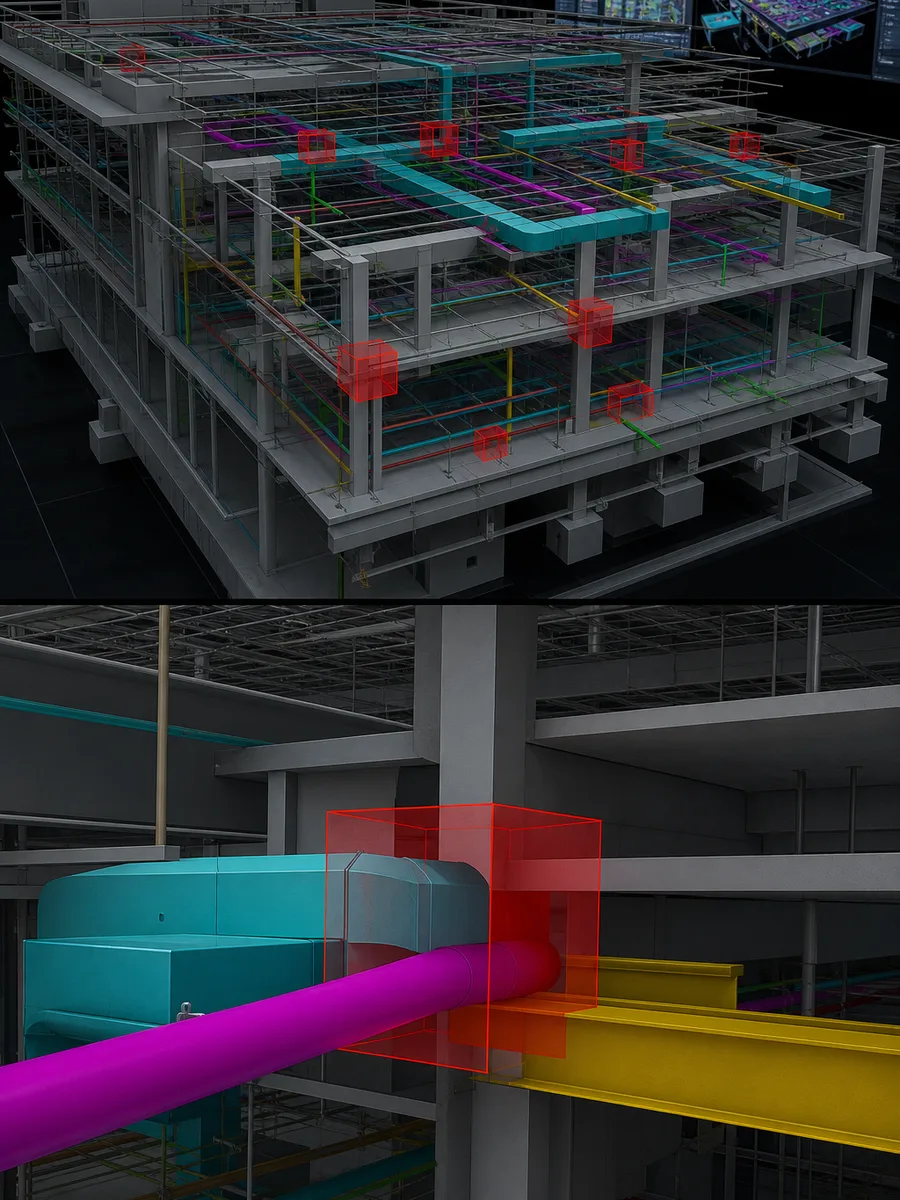
BIM Coordination Failures: Root Causes, Warning Signs, and How to Recover
Why BIM coordination fails on real projects—and how to fix it. Root causes, EU/USA examples, recovery steps, and practices that prevent repeat failures.
BIM Coordination Failures: Root Causes, Warning Signs, and How to Recover
Most teams say they “do BIM coordination.” Many still lose money to field clashes, late redesign, and untrusted models. Coordination failure is rarely a missing software license. It is usually a failure of authority, timing, information quality, or decision hygiene.
This article diagnoses why BIM coordination collapses, how to spot warning signs early, and how to recover a struggling project without rewriting every model from scratch. It is written from the perspective of engineers who have sat through painful clash meetings and fixed the process afterward.
Most failures are process failures wearing software costumes.
BIM coordination is supposed to produce constructible, clash-managed designs and trade models before installation. Failure modes look different on every job, but the outcomes rhyme:
Clash reports with thousands of unsorted issues nobody owns.
Meetings that review screenshots without model updates.
Design models and trade models diverging until nobody knows the authority file.
“Coordinated” ceilings that still cannot fit dampers and cable tray.
Prefabrication released from outdated federations.
Site teams ignoring BIM because the model lagged reality.
Coordination can also fail quietly: the model looks clean because tolerances are too loose, elements are missing, or clashes were suppressed rather than solved. A green clash dashboard is not proof of constructability.
The business impact is measurable—rework, schedule slips, change orders, damaged trust between trades, and facility teams inheriting undocumented compromises. On Scan to BIM renovation projects, coordination failures are worse because existing-conditions uncertainty compounds design uncertainty.
Why It Happens
1. No decision authority
If the BIM coordinator can generate reports but cannot compel resolution, coordination is theater. Someone with contractual power must assign priority and deadlines.
2. Wrong timing
Running serious clash detection after procurement and fabrication commitments wastes the main benefit of BIM. Coordination must precede release gates.
3. Garbage in, theater out
Misplaced links, wrong coordinates, incomplete models, and placeholder geometry create noise. Teams drown in false positives and stop believing the process.
4. Clash quantity over clash quality
Exporting every hard clash without filters teaches people to ignore reports. Priority matrices by system risk are mandatory.
5. Parallel truths
Architect’s Revit, structural analysis model, and MEP trade models disagree. Without a published hierarchy of model authority by phase, field crews pick the loudest voice.
6. Cultural avoidance
Some teams “resolve” clashes by hiding elements, moving problems to future packages, or accepting field coordination as inevitable. BIM then documents failure rather than preventing it.
7. Weak BEP and CDE discipline
If file naming, upload cadence, versioning, and issue tracking are optional, federation rot is inevitable.
8. Skills gaps
Knowing software clicks is not the same as understanding construction sequencing, firestopping, or maintenance access. Pure software operators miss constructability failures that never appear as hard clashes.
9. Contract misalignment
When BIM coordination is specified but payment and liability still follow 2D drawings exclusively, models become optional. People optimize to what they are paid for.
10. Existing-conditions denial
On renovation work, coordinating new design against inaccurate as-builts guarantees elegant digital solutions that fail on site. Scan to BIM QA is part of coordination, not a separate luxury.
Industry Examples (EU/USA)
European Union
EU projects operating under ISO 19650 frameworks still fail coordination when Exchange Information Requirements are copied generically. A hospital project may have a beautiful CDE and still ship uncoordinated shafts because clash responsibility between design and specialist contractors was ambiguous.
Common EU failure patterns:
Over-focus on compliance documentation while under-funding active clash closure.
Late appointment of MEP specialists after architectural freeze.
IFC exchanges that lose critical properties, causing false confidence in openBIM coordination.
Multiple national subcontractors with uneven BIM maturity on one federation.
Successful EU recoveries usually re-baseline information requirements, simplify federation scope to critical systems, and install issue SLAs tied to meeting gates.
United States
US coordination culture is often trade-driven. That can be a strength—mechanical contractors coordinate what they will build. It becomes a failure when design intent models are abandoned too early or when specialty trades (façade, fire protection, controls) join late.
Typical US failure patterns:
Mega clash reports before models are mature.
GC coordination meetings without design decision-makers present.
Tenant improvement clashes with base building never reserved in the model.
Laser scans of existing conditions unused because trade modelers lack time or process to QA against clouds.
High-performing US jobs constrain early coordination to zones of risk—shafts, corridors, plant rooms—then expand. They also bind fabrication release to coordination sign-off.
Both markets fail the same way when incentives, authority, and model quality are misaligned.
Technical Explanation
Without triage and re-test, issue trackers become graveyards.
What “coordinated” should mean
A coordinated state is not zero clashes. It is:
Critical clashes closed or formally accepted with mitigations.
Clearances and access validated for install and maintenance.
Model authority and version locked for the release package.
2D extractions and fabrication data matching the federated state.
Open issues aged, owned, and risk-ranked.
Federation mechanics that break
Failures often originate in:
Incorrect shared coordinates or link positions.
Units mismatches.
Duplicate elements from overlapping responsibilities.
Out-of-date links in the federation file.
View templates that hide the systems under review.
Technical hygiene is boring and decisive.
Issue management architecture
Use a system (BIM 360/ACC Issues, Solibri, Navisworks + connected issue tracker, etc.) where each issue has:
Information clashes (missing fire rating, wrong system type)
Many “coordination failures” are information clashes ignored until inspection.
Relationship to Scan to BIM
If existing conditions are wrong, coordination solves the wrong problem. Define residuals and verification points for Scan to BIM deliverables before using them as coordination baselines.
Organizational failure modes in detail
Coordination collapses when meeting culture replaces decision culture. Classic symptoms include repeating the same clash for three weeks with new screenshots, assigning issues to entire companies rather than named people, and celebrating closed issue counts while site RFIs rise. Another failure mode is expert absence: junior model operators attend while engineers who can accept a reroute do not. BIM coordination is a decision forum supported by models, not a modeling tutorial.
Contract language can also sabotage coordination. If subcontractors are paid for installed quantities regardless of model participation, they will minimize BIM effort. If design consultants are not funded for post-tender coordination support, they will disappear exactly when trade models need answers. Align commercial incentives with coordination outcomes: fabrication release gates, issue SLA expectations, and explicit model authority clauses.
Technical debt that looks like software problems
Many so-called Navisworks or ACC problems are upstream. Duplicate elements from overlapping scopes create thousands of fake clashes. Mis-categorized families break searches and filters. CAD imports explode into unselectable messes. Point clouds linked without section discipline make meetings unusable. Before buying another platform, run a federation health audit: coordinates, link dates, duplicates, units, and model readiness checklist compliance.
On renovation projects, existing-conditions error is a coordination failure multiplier. If Scan to BIM walls are offset systematically, every trade will coordinate into the wrong envelope. Require residual reporting and do not allow coordination kickoff against unverified as-builts.
Metrics that actually predict recovery
Useful metrics include: median age of critical issues, reopen rate, percentage of issues closed with model commits (not screenshots only), number of fabrication packages released without BIM sign-off, and site RFI counts mapped to previously closed clash IDs. Vanity metrics—total clashes found, meetings held, gigabytes uploaded—do not correlate with constructability.
When recovering a failing project, publish a two-week look-ahead of zones, freeze noncritical clash hunting, and restore trust zone by zone. Trust is local before it is global: site teams will believe one coordinated corridor before they believe the entire building again.
Role clarity across design and trade models
Define when the design intent model remains authoritative and when trade installation models take over for specific systems. Hybrid periods are dangerous if unspoken. Publish a RACI for clash types: hard MEP vs structure, façade embeds, fire dampers, ceiling sandwich conflicts, and access clearances. Without RACI, every issue becomes a negotiation about blame instead of a path to resolution.
Best Practices
Unowned clashes are not resolved clashes.
Name a coordination authority in the contract and BEP.
Gate fabrication on coordination sign-off.
Filter clashes by risk, not by raw count vanity.
Require model readiness criteria before meetings (lodging incomplete models wastes everyone’s time).
Publish model authority rules by phase and package.
Keep a rolling 2-week look-ahead of zones to coordinate, aligned to construction.
Bring decision-makers, not only model operators.
Measure issue aging and reopen rates, not only closed counts.
QA federations before meetings—coordinates, dates, visibility.
Integrate existing-conditions verification on renovation and brownfield jobs.
Step-by-Step Recovery Workflow
When coordination is already failing, do not pretend a bigger clash matrix will save you.
Step 1: Stop the bleeding
Pause noncritical clash production. Identify packages heading to fabrication in the next 2–4 weeks.
Step 2: Audit federation health
Verify coordinates, link currency, units, and duplicate content. Fix technical garbage first.
Step 3: Re-baseline scope
Define critical zones and systems for recovery (shafts, plant, corridors, façade interfaces). Explicitly defer low-risk areas.
Step 4: Reset authority
Confirm who decides hierarchy when architecture, structure, and trades conflict. Put it in writing.
Step 5: Install issue SLAs
Every critical issue gets an owner and due date. Track publicly in meetings.
Step 6: Run short, frequent workshops
Replace three-hour screenshot marathons with focused zone sessions and live model navigation.
Step 7: Synchronize deliverables
Ensure drawings, shop drawings, and model exports reference the same federation version ID.
Step 8: Add reality checks
Where installation has started, scan or survey and reconcile. Stop coordinating against obsolete design-only assumptions.
Step 9: Communicate a recovery plan to site
Site teams need to know when the model becomes trustworthy again—and for which zones.
Step 10: Institutionalize the fix
Update the BEP, meeting cadence, and readiness checklist so the failure mode does not return next phase.
Early warning dashboard for BIM managers
Create a simple weekly dashboard: federation health (pass/fail), critical issue median age, issues reopened, packages released without sign-off, attendance of decision-makers, and site RFIs tagged to BIM. If three indicators worsen together, escalate to the project executive immediately. Early escalation saves more money than heroic end-game coordination.
Zone-based coordination vs whole-building theater
Whole-building clash runs on immature models create noise and despair. Prefer zone readiness criteria: required systems present at stated maturity, coordinates verified, and known placeholders labeled. Only then run prioritized clashes. Expand zones with the construction look-ahead. This mirrors how sites actually build and keeps meetings finite.
Human factors and psychological safety
People hide bad news when blame culture dominates. Modelers will suppress clashes rather than surface them if every red mark becomes personal criticism. Leaders should reward early detection. Separate skill coaching from issue accountability. Publicly track package performance, not individual humiliation. Psychological safety is a coordination tool.
Renovation-specific coordination traps
Phasing errors, temporary protection conflicting with new routes, occupied-floor work constraints, and unverified existing hazardous materials locations all break tidy digital plans. Integrate reality capture checkpoints after demolition and before new overhead install. Coordination against a pre-demolition cloud after walls are gone is self-deception. Update baselines when the building changes.
Case Study
Project type: Mid-rise laboratory renovation with dense MEP and phased occupancy.
Failure symptoms: Clash meetings produced 8,000+ issues. Trades stopped attending. Site discovered duct/steel conflicts weekly. The Scan to BIM model of existing conditions was present but unused in federation.
Recovery actions:
Technical audit found two MEP links placed on wrong elevations and an outdated structural model still federated.
Coordination scope narrowed to Level 2–4 shafts and Level 3 corridor spine for 21 days.
Issues reduced to a filtered critical set (~180) with owners and 5-day SLAs.
Existing-conditions QA selected 40 verification points; model adjustments corrected three systemic offsets.
Fabrication releases required BIM lead sign-off referencing federation version IDs.
Outcome: Within one month, site clash RFIs in the recovered zones dropped sharply. Attendance returned because meetings produced decisions. The project did not become perfect; it became manageable and trustworthy in the areas that mattered for the current phase.
Common Mistakes
Equating clash count reduction with coordination success.
Inviting everyone to every meeting.
Coordinating incomplete placeholder models.
Letting suppressed elements create fake clean reports.
No link between clash closure and drawing updates.
Ignoring soft clearances and access.
Starting over with new software instead of fixing process.
Hiding bad news from the client until field failure.
Treating Scan to BIM as decorative context.
Closing issues without model commits.
Expert Tips
Start every meeting with federation metadata: date/time of each link and coordinate proof screenshot.
Use a top 20 critical issues board visible to the project exec.
Color trades consistently across all views to speed recognition.
For renovation, never trust a single section; validate against cloud in multiple locations.
Separate design intent coordination from installation model coordination—different maturity, different rules.
If a trade cannot update models within the SLA, escalate early; silent lag kills federations.
Protect modelers from endless meeting culture; give them resolution time.
Write “definition of coordinated” into subcontracts in plain language.
Future Trends
Coordination platforms are moving toward continuous issue graphs connected to CDE versions, automated rule checking, and AI-assisted clash clustering. That helps—but it will not invent missing authority or fix wrong existing conditions.
Expect more owner-mandated model maturity gates and more use of reality capture to verify installation against coordinated models. OpenBIM rule checking will expand in EU public work. US trade coordination will increasingly connect fabrication machines directly to signed model states.
The enduring differentiator will remain human: clear ownership, construction literacy, and honest readiness criteria.
Playbook: first 10 days of a recovery
Day 1–2: freeze noncritical clash production; audit coordinates and link currency; identify fabrication releases inside 30 days. Day 3–4: publish critical zone list and authority RACI; reset issue tracker priorities. Day 5–6: run focused workshops on the top risk zone only; close or formally accept issues with model commits. Day 7–8: reconnect drawings/shop drawings to federation version IDs; communicate trust status to site. Day 9–10: expand to the next zone; update BEP addendum so the failure mode cannot silently return. This playbook is intentionally narrow. Wide simultaneous recovery usually recreates noise.
Software selection is not the root fix
Switching from one clash platform to another mid-crisis rarely saves a project. People bring their habits with them. Fix readiness criteria, authority, and incentives first. Introduce new tools only when the process can absorb them—typically after a zone has been successfully recovered and the team trusts the rhythm again.
FAQ
Is zero clashes realistic?
No. Aim for zero unresolved critical clashes and formally accepted residuals.
Who should run coordination—GC, designer, or third party?
Whoever has contractual authority and construction literacy. Third parties can facilitate, but authority must be explicit.
How often should we federate?
Match construction risk. Weekly is common in peak periods; critical zones may need faster cycles.
What is the fastest sign coordination is failing?
Site RFIs repeating issues already “closed” in BIM, or trades skipping meetings.
Can AI fix coordination failures?
AI can cluster and prioritize. It cannot replace decisions, contracts, or accurate existing-conditions data.
How do Scan to BIM errors show up in coordination?
As systemic offsets, repeated local clashes along one gridline, or perfect digital fits that never match site measurements.
Summary
BIM coordination fails when authority, timing, model hygiene, and incentives are wrong—not merely when software is absent. EU and USA projects share these failure modes despite different standards language. Recovery requires re-baselining critical zones, fixing federation health, enforcing issue SLAs, and reconnecting models to fabrication gates and reality. Prevention is clearer definitions of “coordinated,” readiness criteria, and continuous ownership.
CTA
If your federation is noisy, untrusted, or ignored on site, Bimzstudio can help with Scan to BIM baselines, model QA, and coordination-ready existing-conditions packages that give clash processes something true to work against. Share your project type and current pain points to discuss a recovery-oriented approach.