Clash Detection Workflow: From Federated Models to Resolved Field Risk
A practical clash detection workflow for BIM teams: rulesets, priorities, issue tracking, LOD gates, Scan to BIM checks, and sign-off methods that reduce rework.
Clash Detection Workflow: A Field-Tested Process for Multidisciplinary BIM
Clash detection is only valuable when it is embedded in a workflow: correct inputs, tuned rules, prioritized triage, owned resolutions, re-testing, and sign-off. Without that workflow, teams drown in thousands of alerts, suppress the wrong conflicts, and still discover pipe-versus-beam collisions after demolition.
This article lays out a complete clash detection workflow for design and construction teams, including renovation-specific steps that use Scan to BIM and point cloud QA/QC, with practices relevant to EU and U.S. project delivery.
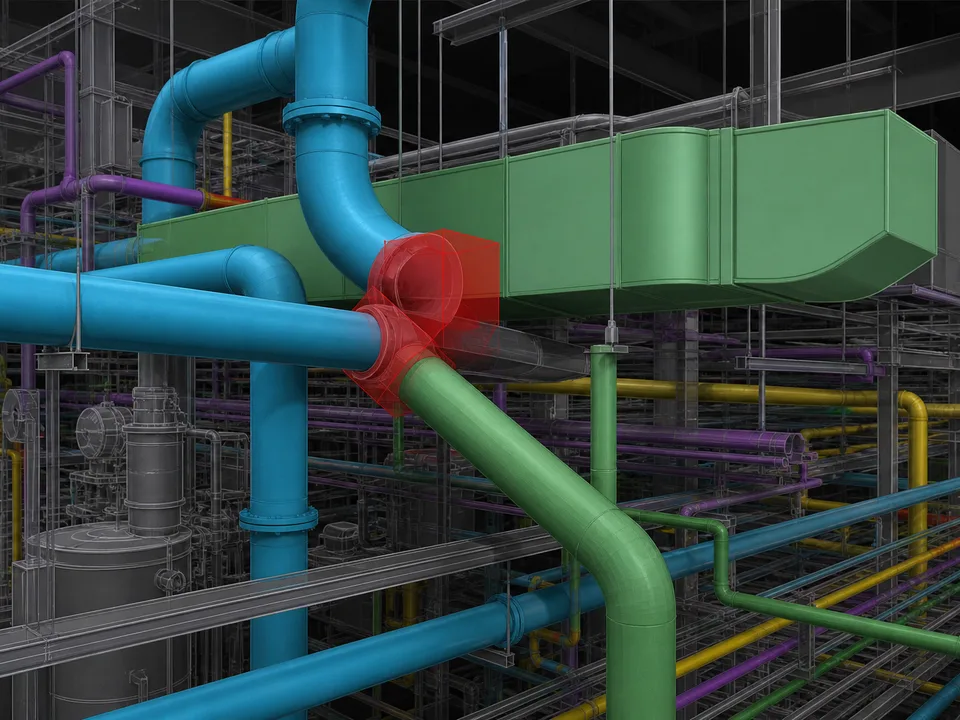
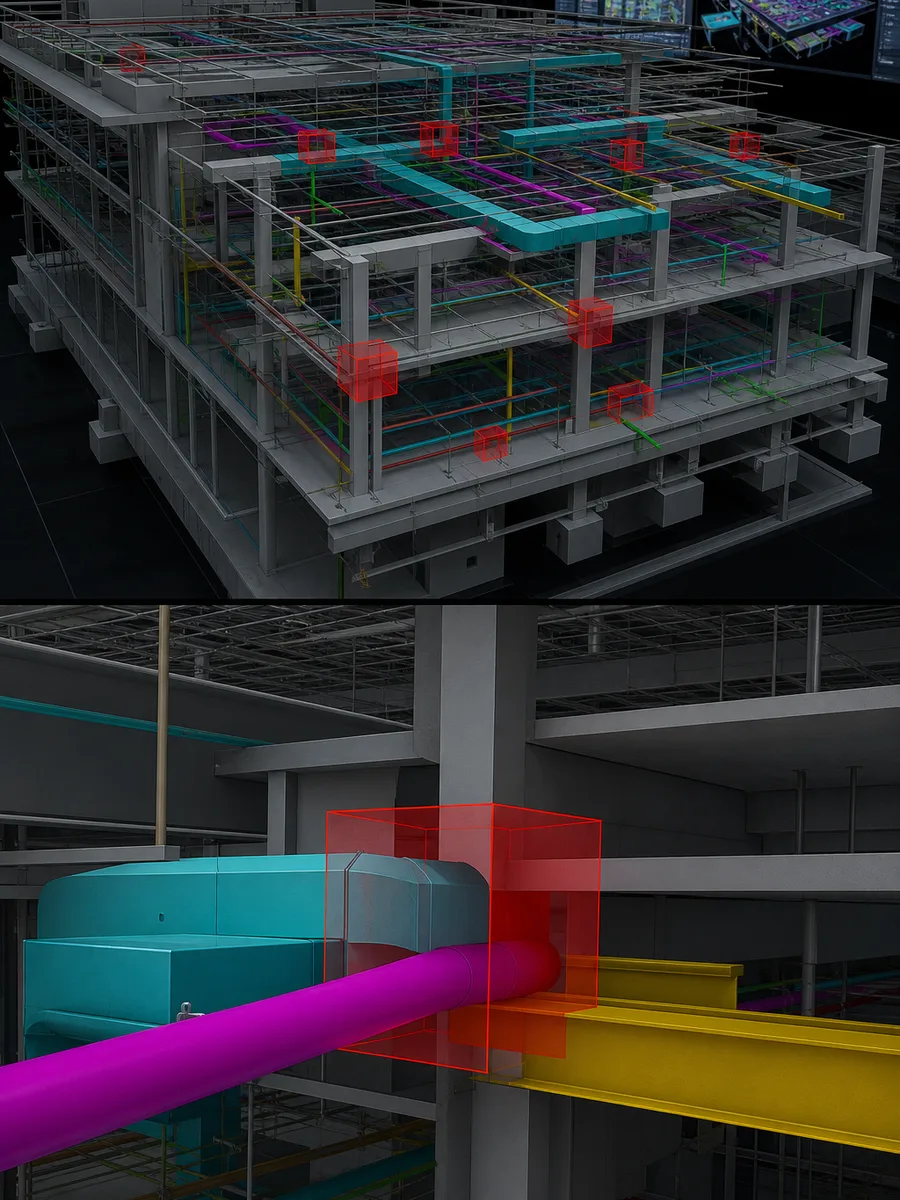
Clash detection compares model elements to find interferences and clearance violations. On paper, it sounds binary: clash or no clash. In practice, it is a quality-control system that must answer:
Are we comparing the right model versions?
Are elements developed enough to make clashes meaningful?
Which clashes threaten life safety, drainage, or prefabrication?
Who changes what by when?
Did the fix create new conflicts upstream/downstream?
Are we coordinating against real existing conditions?
Projects fail when detection is treated as a button press. A robust clash detection workflow treats it as a gated production process with evidence.
Why It Happens
Rulesets are copied blindly
A hospital ruleset applied to a warehouse—or an LOD 400 ruleset applied at schematic design—creates chaos.
Version chaos
One trade uploads Tuesday’s model; another reviews Monday’s architecture. “Resolved” clashes reappear like ghosts.
No distinction between signal and noise
Placeholder families, duplicated linked elements, and temporary objects flood reports.
Resolution theater
Meetings mark issues complete because someone promised a fix, not because the model changed and re-tested clean.
Existing building blindness
New work is clash-free internally while intersecting unscanned or unmodeled existing utilities.
Industry Examples (EU / USA)
European Union
Complex public renovations use clash workflows inside broader information exchange gates.
Industrial projects often prioritize process pipe and access clashes before architectural cosmetics.
Soft clashes often prevent the worst field failures because equipment that “fits” but cannot be serviced is still a failure.
Grouping logic
Smart workflows group by:
Location grid/level
System pair (e.g., duct vs sprinkler)
Root element causing many hits
Trade owner
Grouping turns 5,000 alerts into 120 decisions.
Re-test strategy
Full-building re-clash every cycle is slow and noisy. Prefer:
Zone boxes
System pair deltas
Elements modified since last run
Keep a periodic full run as a safety net.
Best Practices
Priority and ownership turn clash noise into field risk reduction.
Freeze a clash code dictionary (priority, type, disposition codes).
Reject noncompliant model submissions before detection.
Run detection on published versions only.
Triage within 24–48 hours on critical projects.
Require model evidence for “resolved.”
Separate false-positive tuning from real design conflict resolution.
Include existing-conditions clashes for renovations.
Connect clash milestones to fabrication hold points.
Report KPIs to project leadership (aging critical issues).
Archive rulesets with the milestone for auditability.
Building Rulesets That Teams Trust
A ruleset is a hypothesis about what matters now. Treat it like engineered criteria.
Start with system pairs that kill schedules
Examples:
Structure vs large duct
Structure vs cable tray mains
Gravity pipe vs everything beneath
Fire protection vs access clearances
New work vs existing Scan to BIM elements
Delay accessory-level detection
Hangers, small conduit, and fixtures create enormous noise early. Introduce them when LOD and install strategy justify the signal.
Encode clearances explicitly
If maintenance access is 750 mm in front of a panel, put it in the soft-clash rules—do not rely on tribal knowledge.
Version rulesets
Rules_L03_PrefabGate_v3 is better than final_FINAL_clashes. When disputes arise months later, you can prove what was checked.
Issue Writing Standards
Bad issue: “Duct clash in corridor.”
Good issue: “P1 hard clash — AHU-2 supply main (Mech v12) intersects Beam B-12 at Grid C/4, Level 03. Proposed: drop duct 150 mm or revise beam penetration with structural approval. Owner: Mech lead. Due: 48 hours. Viewpoint + section attached.”
Train every coordinator on this standard. Issue quality determines resolution speed.
Prefabrication Hold Points
Link clash workflow to fabrication:
Zone spatially allocated
Critical clash classes cleared
Install sequence reviewed
Spool/rack drawings released
Field verification plan agreed
If fabrication starts while P1 issues remain “in discussion,” the workflow failed—even if detection software ran perfectly.
Renovation-Specific Detection Notes
Clash against verified existing models, not only new trades
Visually confirm suspicious existing geometry in the point cloud
Treat low-confidence existing zones as risk registers, not as cleared space
Update as-builts when demolition reveals surprises; re-clash affected zones
Example Weekly Cadence (Detailed Coordination Phase)
Monday: Trades publish milestone models to CDE by 10:00. Automated preflight checks run.
Monday PM: Coordinator federates, confirms versions, runs priority rulesets on active zones.
Friday AM: Incremental re-clash on changed elements/zones. Close verified fixes.
Friday PM: KPI update to project leadership; update zone release forecast.
Adjust for faster or slower projects, but keep the publish → detect → triage → fix → re-test loop intact. Breaking the loop is how clash detection workflows decay into screenshot theater.
Clearance and Code-Adjacent Thinking
Not all soft clashes are aesthetic preferences. Some protect:
Valve operation
Filter replacement
Electrical working clearances
Fire damper access
Housekeeping pads and future coil pulls
Patient lift and equipment paths in healthcare
Coordinate with discipline engineers and facility operators when defining soft-clash envelopes. A purely geometric hard-clash culture will still fail commissioning and maintainability reviews.
From Clash Report to Change Order Reality
Not every clash resolution is free. A mature clash detection workflow distinguishes:
Internal coordination adjustments within a trade’s design responsibility
Cross-trade agreements with no cost impact
Scope/design changes needing owner approval
Existing-conditions discoveries from Scan to BIM that alter assumptions
Route each disposition correctly. Dumping cost-bearing changes into “BIM coordination” without commercial process creates underground agreements and later disputes. Conversely, escalating every trivial duct nudge as a change order destroys schedule.
Document disposition codes in the issue tracker. Your future self—and your claims consultant—will thank you.
Visual Standards for Viewpoints
Require every P0/P1 issue to include:
3D viewpoint with conflicting elements isolated
Section or elevation showing clearance context
Grid/level annotation
Model version labels in the screenshot or description
Viewpoint quality is part of the workflow, not decoration. Poor visuals create circular meetings.
Common Ruleset Pitfalls
Avoid these patterns when configuring detection:
Testing placeholders against fabrication models
Including linked CAD underlays that duplicate BIM elements
Using tolerance settings so tight that mesh approximations create noise
Ignoring level offsets between discipline models
Running soft clashes without published clearance definitions
Mixing work-in-progress links into a published federation
A short ruleset validation on a known-good sample bay prevents days of polluted reports. Treat rulesets as engineered artifacts: test, version, and retire them deliberately.
When renovations include Scan to BIM existing models, add a dedicated ruleset family for new-vs-existing pairs. Those conflicts are often the ones that hurt most in the field—and the easiest to miss if your template only contemplates new-build trade pairs.
Finally, remember that clash detection is a communication system as much as a geometric test. The workflow succeeds when fabricators, installers, and designers share the same definition of “cleared,” the same model versions, and the same evidence standard for closure. If those social contracts are missing, even perfect rulesets will not protect the ceiling plenum.
Keep the workflow boringly consistent. Boring consistency—publish, detect, triage, fix, re-test, sign off—is what separates projects that discover conflicts in software from projects that discover them with a reciprocating saw above a live corridor.
Step-by-Step Solution
Step 1: Define success for this milestone
Example: “Level 03 interstitial coordinated for prefab rack release—no open P1 hard clashes; P1 soft clashes mitigated or accepted with sign-off.”
Step 2: Confirm LOD and clearance matrix
If elements are not ready, do not pretend detection will save them.
Step 3: Collect and validate federated inputs
Include architecture, structure, MEP trades, fire protection, and verified as-builts/clouds as required.
Step 4: Select/tune rulesets
Start with high-signal pairs. Expand as models mature.
Step 5: Execute detection and auto-group
Export to the issue tracker with locations and viewpoints.
Step 6: Facilitated triage workshop
Discipline leads classify: fix now / redesign / accept with rationale / false positive.
Step 7: Assign owners and due dates
No issue without an owner. Critical issues get short clocks.
Step 8: Update models and comment with version references
“Fixed in Mech_v18” beats “fixed.”
Step 9: Incremental re-clash and close loop
Close only when re-test confirms. Watch for relocated conflicts.
Step 10: Milestone sign-off package
Include open accepted risks, suppressed false positives log, and model version list.
Renovation add-on steps
Clash new work against Scan to BIM existing model
Visually verify contested areas against point cloud
Flag low-confidence existing zones where cloud voids remain
Case Study
Project: Data hall MEP intensification inside an existing EU industrial shell Problem: Early clash runs produced >8,000 results; team morale collapsed; schedule slipped.
Workflow reset:
Stopped whole-building “everything vs everything”
Validated coordinates and purged placeholder content
Created milestone rules: structure vs mains, then mains vs mains, then accessories
Grouped by aisle and rack line
Required re-test evidence for closure
Brought static scan-verified as-builts into the federation for existing steel and utility stubs
Result: Within three cycles, P1 open issues were manageable, prefabrication drawings released for the first aisles, and field RFIs related to overhead conflicts dropped sharply. The software did not change—the clash detection workflow did.
Common Mistakes
Equating zero clashes with readiness while systems are missing
Closing issues without re-testing
Using one ruleset from concept through fabrication
Ignoring soft clashes until commissioning
Clash detecting personal working models
No link between clash gates and procurement/prefab
Suppressing recurring clashes instead of fixing families/standards
Forgetting existing conditions on renovations
Not capturing accepted deviations in writing
Letting viewpoints replace section understanding
Expert Tips
Write P0/P1 definitions in contract language everyone can recite.
Clash the congested bay first to calibrate culture and rules.
Keep a living false-positive library to speed triage.
Use 4D only after 3D spatial logic is stable—sequence won’t fix impossible geometry.
Invite the installer to one triage per zone before rack freeze.
When debates stall, cut a section through the cloud and model together.
Protect the coordinator from being the unpaid designer for every trade.
Measure workflow health weekly with a simple aging chart.
Future Trends
ML-assisted clash clustering and likely root-cause ranking
Automated model readiness scoring before detection
Continuous integration style model checks on every publish
Tighter digital twin feedback when installed work differs from coordinated models
Uncertainty-aware clashes that weight unverified existing conditions differently
Detection will get faster. Accountability will remain the hard part.
FAQ
1. What is a clash detection workflow?
A gated process that validates inputs, runs prioritized interference/clearance checks, triages and assigns issues, verifies fixes through re-testing, and signs off zones against agreed criteria.
2. Which tool is required?
Multiple platforms can execute detection. The workflow—version control, rules, ownership, re-test—matters more than the logo.
3. How do soft clashes differ from hard clashes?
Hard clashes are geometric intersections. Soft clashes violate clearance, access, or other envelopes. Both can be project-critical.
4. When should clash detection start?
As soon as models have enough reliable geometry to support decisions—typically once LOD 300 system definitions exist for the systems being coordinated. Earlier runs should be limited and purpose-built.
5. How does Scan to BIM affect clash detection?
It provides verified existing conditions so new design can be tested against reality, not only against other new design models.
6. How many clashes is “normal”?
Raw counts are poor KPIs. Track critical open issues, aging, and recurrence after fixes.
7. Should trade fabrication models be clash detected?
Yes, at interface milestones. Design-to-fab and fab-to-fab clashes are common sources of field pain if skipped.
8. What belongs in a clash sign-off package?
Model versions, ruleset IDs, open/accepted issues, false-positive log, zone boundaries, and responsible signatories.
Summary
A clash detection workflow converts interference checking from a noisy report into controlled risk reduction. Success depends on ready inputs, milestone-tuned rulesets, ruthless triage, owned fixes, re-testing, and—on renovations—Scan to BIM truth with QA/QC. EU and U.S. complex projects benefit equally from treating detection as a gated production system tied to fabrication and install release.
If your team is drowning in clashes, do not only buy another tool. Repair the workflow.
Need Clash-Ready Existing Conditions?
Bimzstudio helps teams feed coordination and clash detection with verified Scan to BIM models—LOD-defined, QA/QC’d against point clouds, and structured for federated reviews. For EU and U.S. renovations, starting from accurate existing conditions is often the highest-leverage clash reduction step available.
Share your federation challenges and as-built status, and we can help you establish a model baseline worth clash detecting.