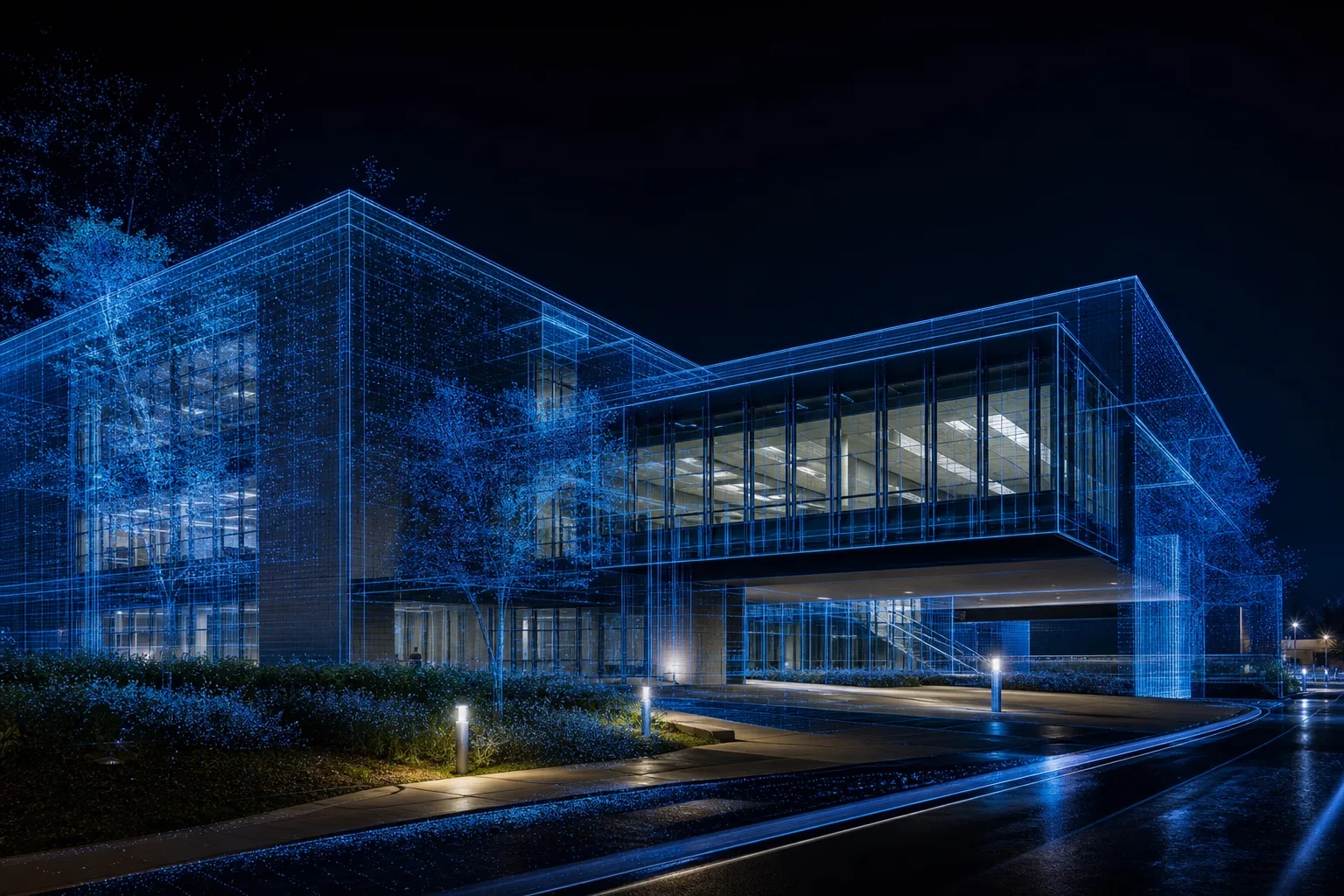
The Future of Scan to BIM: Where Reality Capture Is Heading Next
Explore the future of Scan to BIM—AI automation, continuous scanning, open standards, and delivery models that will redefine as-built BIM through 2030.
BimzstudioJul 29, 202616 min
Scan to BIMfuture of BIMreality capturedigital twinsAI Scan to BIM
The Future of Scan to BIM: Where Reality Capture Is Heading Next
Scan to BIM is graduating from a specialized survey product into a core operating capability for renovation, industrial turnarounds, and increasingly for verification of new construction. The next decade will not be defined by a single scanner brand or a single AI demo. It will be defined by how reliably teams convert continuous reality data into trusted, decision-grade models—on schedule, at known quality, under clear contracts.
This article looks forward with a practitioner’s skepticism. It separates durable trends from hype, maps implications for European and US markets, and outlines what owners, GCs, and BIM providers should prepare for now.
Faster capture and AI assist still need contract-grade QA language.
Today’s Scan to BIM still behaves like a batch process: mobilize, scan, register, model, issue, argue about LOD. That pattern works, but it is slow relative to the pace of facility change and construction verification needs. Owners want living as-builts. Contractors want weekly installation proof. Designers want existing-conditions models earlier and cheaper. Labor markets cannot scale linear modeling hours forever.
The industry problem is a mismatch between data abundance and model scarcity. Capturing points is getting easier. Turning points into trustworthy BIM remains expensive and expertise-heavy. If that gap stays wide, organizations will drown in clouds they cannot use—or worse, make decisions on unverified automations.
The future of Scan to BIM is therefore a production-systems problem: automation, standards, continuous capture, contractual clarity, and workforce evolution must advance together.
Why It Happens
Several forces are pushing the discipline to reinvent itself.
Renovation dominance. In mature EU markets and aging US building stock, work happens inside existing assets. Existing-conditions intelligence becomes the critical path.
Labor and cost pressure. Clients refuse to pay forever for fully manual tracing of repetitive geometry.
Tooling maturation. Scanners are faster, mobile mapping is more usable indoors, photogrammetry and Gaussian-splat visualization are democratizing reality views, and AI classification is entering commercial pipelines.
Digital twin ambitions. Owners discover that twins without reliable geometry and semantics are dashboards on wishful thinking.
Verification culture. Progressive GCs scan to verify installed work against design BIM, collapsing the old boundary between “as-built survey” and “construction control.”
Standards and mandates. ISO 19650 information management and owner EIR requirements force clearer definitions of what as-built information means—and what evidence supports it.
These forces collide with legacy contracts that still treat scans as optional pictures and models as drawings with extra clicks. The friction between new capability and old commercial models is why the future arrives unevenly.
Industry Examples (EU/USA)
Europe: retrofit industrialization
Energy performance mandates and public estate upgrades are industrializing Scan to BIM for housing, schools, and hospitals. Nordic and Dutch programs experiment with productized capture-to-model pipelines for repeated typologies. The future here looks like parameterized as-built production lines: same taxonomy, same QA, same LOD matrices across hundreds of assets, with AI handling repetitive fabric and humans handling exceptions.
Cross-border EU projects also push openBIM and IFC-centric deliverables harder than many US jobs, shaping a future where Scan to BIM outputs must remain usable outside a single proprietary ecosystem.
United States: verification and industrial tempo
US industrial turnarounds and healthcare renovations are driving “scan often, model what matters” strategies. Instead of modeling every conduit to fabrication LOD, teams classify broadly and model critical systems deeply. Aviation and stadium programs use rapid resurveys to keep coordination models current during long phasing.
Owner-operators with large campuses are moving toward subscription reality capture—quarterly mobile scans plus targeted TLS—feeding both capital planning and FM. The US future of Scan to BIM is less a single deliverable and more a recurring service level.
Technical Explanation
Pipelines will compress — accountability for accuracy will not disappear.
The technical future consolidates around five layers.
1. Multi-sensor capture fabrics
Static TLS remains the accuracy anchor. Mobile lidar, SLAM backpacks, drone photogrammetry, terrestrial photogrammetry, and panoramic imagery fill coverage and speed gaps. Sensor fusion pipelines will normalize these into common coordinate frameworks with explicit uncertainty fields—not fake uniform precision.
2. Continuous registration and control
Permanent control networks, survey markers, and increasingly vision-based relocalization will make resurveys cheaper. The future model is not “register from scratch” every time; it is “localize against the digital site.”
3. AI perception and assisted modeling
Semantic segmentation, instance detection, and constrained generative modeling will draft architecture and some MEP automatically. The durable pattern is human-in-the-loop autonomy with confidence gating. Fully unsupervised fabrication BIM remains a risky fantasy for congested systems.
4. Model products, not only models
Deliverables will diversify: deviation heatmaps, occlusion reports, classified clouds, partial BIM packages by system criticality, and twin-ready semantic graphs. A single monolithic RVT will not be the only answer.
5. Interoperability and twin sync
IFC, open point cloud semantics, APIs to CMMS/BAS, and IDS-style information validation will determine whether Scan to BIM feeds operations or dies in archive folders. The technical winner is the pipeline that preserves provenance: which scan, which algorithm version, which human approval created each object.
Uncertainty will become a first-class attribute. Future professional practice should report not only coordinates but confidence and fitness-for-purpose per element class.
Best Practices
Even while technology moves, certain practices future-proof teams now:
Write LOD and information requirements by use case, not by habit.
Separate capture contracts from modeling contracts carefully, with shared QA language.
Invest in taxonomy and naming before buying more AI seats.
Pilot automation on repetitive scopes with measurable KPIs.
Keep open formats in the handover package even if authoring stays native.
Align Scan to BIM with twin and FM roadmaps early, or accept rework later.
Update commercial templates to define AI-assisted methods and liability boundaries.
Step-by-Step Preparation Roadmap
Step 1: Audit current Scan to BIM maturity
Measure cycle times, rework causes, LOD disputes, and file chaos. You cannot future-proof a process you have not measured.
Step 2: Define target operating model for 3–5 years
Decide whether you need project-based as-builts, continuous verification, twin feeding, or all three. Different futures need different investments.
Step 3: Standardize taxonomies and QA gates
Create class dictionaries, tolerance tables, and acceptance sampling methods that can survive tool changes.
Step 4: Build a golden dataset
One fully validated package becomes your regression test for every new scanner, software, or AI model.
Step 5: Introduce assisted automation narrowly
Automate walls/floors or classification first. Protect fabrication-critical systems from premature autonomy.
Step 6: Implement resurvey playbooks
Control densification, localization methods, change detection outputs, and update rules for the living model.
Step 7: Upgrade contracts and BEPs
Include processing methods, AI review roles, provenance requirements, and deliverable product list.
Step 8: Upskill the workforce
Move staff from pure tracing toward exception handling, QA analytics, and client advisory.
Step 9: Integrate with CDE and FM systems
Test round-trips of geometry and attributes before promising twin outcomes.
Step 10: Review annually annually against KPIs
Kill tools that do not move cycle time, first-pass yield, or field RFI rates.
Case Study
A multinational owner with assets in Germany and the US Midwest ran parallel Scan to BIM pilots to prepare a 2030 digital estate strategy. The European pilot focused on housing typologies with AI-assisted architectural extraction and IFC handover. The US pilot focused on a process unit with ML classification and selective LOD 400 modeling for shutdown-critical lines.
After twelve months:
Average architectural as-built cycle time on repeated EU housing blocks fell 34% through standardized capture and assisted modeling.
US turnaround planning cut “interpretation weeks” by using classified scopes in bid packages; contractor RFIs about existing conditions dropped noticeably in the next outage.
Both regions adopted a shared provenance schema (scan ID, registration report, classification model version, approver).
Attempts to auto-model small-bore piping failed acceptance and were explicitly excluded from the automation roadmap—an honest outcome that saved future pain.
The owner’s EIR was rewritten to request productized Scan to BIM outputs (classified cloud + BIM + deviation report) rather than “model from scan” as a vague line item.
The strategic lesson: the future arrived faster where standards and commercial language matured alongside technology.
Common Mistakes
Waiting for perfect AI before improving process. Fundamentals compound; hype does not.
Equating visualization with BIM. Pretty walkthroughs are not parametric, maintained information.
One LOD for everything. Future economics require selective depth.
Ignoring openBIM until handover week. Late conversion destroys attribute fidelity.
No resurvey strategy. Twins die when the first model ages.
Buying scanners without production design. Hardware is easy; throughput design is hard.
Underestimating change management. Modelers need new skills and incentives.
Promising unsupervised fabrication models in marketing. Credibility matters more than buzzwords.
Fragmenting data across unmanaged drives. Future pipelines need CDEs and retention rules.
Treating US and EU requirements as identical. Procurement, standards, and privacy contexts differ.
Expert Tips
Track cost per validated square meter (or per asset system), not cost per scan day alone.
Make occlusion and uncertainty reports standard deliverables; they educate clients and reduce disputes.
Use phased autonomy: suggest → draft → sample-auto-commit.
Align AI vendors with your taxonomy, not the other way around.
Keep surveyors in the loop; georeferencing mistakes become enterprise mistakes in twin era.
Design packaging for modelers: zone boxes, discipline filters, notes—not raw enterprise dumps.
Build dual delivery capability: native models for coordination, open formats for longevity.
Create a risks register for automation failure modes and revisit it quarterly.
For continuous scanning, decide update triggers (time-based, event-based, deviation-based).
Partner with contractors on verification scans during construction—do not wait for “final as-built.”
Future Trends
Continuous capture and twins will push Scan to BIM toward living assets.
Looking toward 2030, expect:
Capture as a service embedded in facilities operations, not only capital projects.
Near-real-time verification where weekly scans update progress and clash against design.
AI copilots for modelers that propose geometry and parameter completions inside authoring tools.
Semantic point cloud standards that travel cleanly into IFC and twin platforms.
Uncertainty-aware BIM, where elements carry fitness-for-purpose metadata.
Tighter coupling of Scan to BIM with prefabrication, using field verification to close fabrication loops.
Regulatory expectations for evidence-backed as-builts on critical public assets.
Workforce shift from tracing technicians to reality-systems engineers.
What will not vanish: the need for professional judgment on congested MEP, heritage fabric, structural safety, and contractual accountability. The future belongs to hybrid industrial processes, not lights-out modeling factories.
Operating Models That Will Dominate
Three operating models are emerging. Most large organizations will run a blend.
Project as-built model: Classic Scan to BIM for a capital project. Still essential for renovations and handovers. Future improvements come from faster processing and assisted modeling, not from abandoning the project frame.
Verification scanning during construction: Weekly or milestone scans compared to design BIM. The “model” may be a deviation product more than a full remodel. This collapses punch and coordination loops.
Estate reality service: Subscription capture across portfolios with selective modeling triggers. Ideal for campuses and public estates. Success depends on stable taxonomies and update SLAs more than on any single software brand.
Choosing the wrong operating model wastes money. A hospital system that only buys project as-builts will never keep a twin current. A small one-off tenant fit-out does not need an estate reality service.
Contract language that must evolve
Future-ready appointments should specify:
Capture methods and accuracy classes by zone
Processing and AI assistance disclosures
Provenance metadata requirements
Product list (classified cloud, BIM, deviation report, occlusion map)
Human review responsibilities for critical systems
Resurvey triggers after substantial changes
Open format handover expectations
Without this language, vendors optimize for cheapest file delivery, and owners receive beautiful but unmaintainable outputs.
Skills and organizational design
The Scan to BIM team of 2030 looks less like a pure tracing pool and more like a hybrid cell:
Reality capture surveyors who understand control and uncertainty
BIM modelers who excel at exception handling and constructability
Automation specialists who maintain scripts, classifiers, and QA dashboards
Information managers who keep taxonomies and CDE states coherent
Client advisors who translate fitness-for-purpose into scope
Training programs should stop treating “AI” as a separate elective and start treating confidence maps, sampling QA, and provenance as core professional competence.
What not to wait for
Do not wait for perfect autopilot before:
Cleaning your LOD matrices
Creating a golden dataset
Standardizing class dictionaries
Instrumenting cycle-time KPIs
Writing resurvey playbooks
Those investments compound under every future tool generation. Waiting for a vendor to erase process debt is how organizations stay permanently “about to transform.”
Economic outlook for providers and owners
Unit prices for raw scanning will keep falling. Prices for trusted, decision-grade BIM will not fall at the same rate—because trust requires QA labor, exception handling, and liability. The market will bifurcate: cheap visualization clouds versus certified as-built information products. Owners who buy only on lowest scan day-rate will fund the first category and wonder why coordination still hurts.
Providers that industrialize hybrid production—AI plus senior review plus transparent provenance—will defend margin. Providers that race to unsupervised autopilot on complex MEP will donate their insurance premiums to future claims.
Near-term adoption checklist (next 12–24 months)
Publish a Scan to BIM product catalog with clear use cases.
Add AI disclosure and review roles to BEP templates.
Build one golden dataset per major asset class you serve.
Instrument cycle time and first-pass yield dashboards.
Pilot assisted architectural extraction or classification—not full autopilot.
Negotiate resurvey frameworks with campus/industrial clients.
Train staff on confidence maps and sampling QA.
Align open format handover tests with client EIRs.
Complete that list and you are future-ready regardless of which vendor wins the next hype cycle.
Client communication in the AI era
Set expectations explicitly in proposals: assisted automation will accelerate repetitive zones; congested and heritage zones remain expert-led; deliverables include confidence and deviation evidence; schedule gains assume scan quality gates are met. Clients who hear only “AI Scan to BIM” without those caveats become disappointed clients—and disappointed clients create market backlash that slows good adoption.
FAQ
Will Scan to BIM become fully automatic?
Parts will. End-to-end unsupervised BIM for complex assets is unlikely to be trusted for high-risk uses in the near term.
Are point clouds enough without BIM?
For visualization, sometimes. For coordination, quantities, and FM workflows, structured BIM (or equivalent semantics) remains necessary.
How should owners budget for the future?
Budget for recurring capture + selective modeling + information management, not only one-time as-builts.
What skills should we hire?
Reality capture survey competence, BIM coordination, data standards literacy, and comfort with AI QA—not prompt typing alone.
Do Gaussian splats replace Scan to BIM?
They improve visualization and communication. They do not replace parametric, rule-checkable design models.
Is IFC mandatory for the future?
Not always contractually, but open, validated handover formats dramatically improve long-term usability.
How fast will AI cut costs?
Expect stepwise reductions on repetitive scopes over multiple projects, not overnight collapse of all modeling fees.
What should we do this year?
Standardize taxonomy/QA, pilot assisted automation, and rewrite EIRs/BEPs to match how you will actually work.
Summary
The future of Scan to BIM is continuous, selective, AI-assisted, and contractually explicit. Reality capture will be easier; trust will still be earned through registration quality, provenance, human review, and clear fitness-for-purpose definitions. European retrofit industrialization and US verification/industrial use cases are already rehearsing that future. Teams that invest now in standards, golden datasets, resurvey playbooks, and hybrid skills will outpace those waiting for a magic autopilot.
CTA
Ready to modernize your Scan to BIM operating model—not just buy another tool? Bimzstudio helps owners and project teams design capture, AI-assisted processing, and modeling pipelines built for the next decade of as-built delivery. Start a conversation with our specialists today.