The Future of Digital Twins: From Static Models to Living Asset Intelligence
See where digital twins are heading—BIM foundations, IoT integration, AI analytics, and governance models that turn static as-builts into living asset intelligence.
BimzstudioJul 29, 202616 min
digital twinsBIM digital twinsmart buildingsIoT BIMasset intelligence
The Future of Digital Twins: From Static Models to Living Asset Intelligence
Digital twins have been over-promised and under-specified for years. Too many programs begin with a glossy dashboard and an orphaned BIM model, then stall when data pipelines, governance, and operational ownership are unclear. Yet the underlying idea remains sound: a living digital representation that helps people decide better about a physical asset. The future belongs to organizations that treat twins as operational systems with BIM, reality capture, IoT, and workflows—not as a one-time 3D brochure.
This article maps a realistic future for digital twins in the built environment, grounded in Scan to BIM practice, information management, and what is already working in European and US portfolios.
Twins mature when data contracts and OT integration mature.
Most “digital twin” initiatives fail the usefulness test within eighteen months. Geometry is outdated. Sensors are siloed. Asset IDs do not match. Facility teams keep using spreadsheets. Executives see a 3D model and ask why maintenance KPIs did not move.
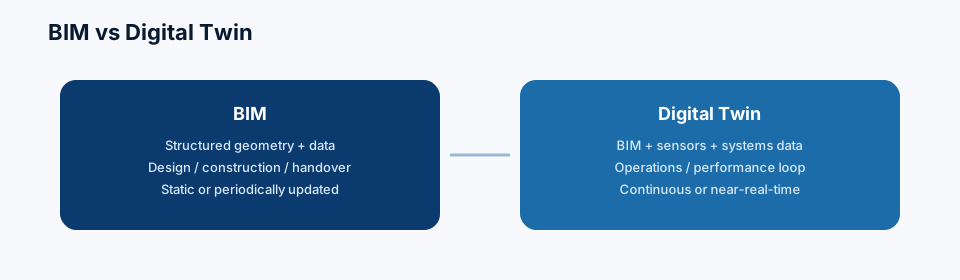
The problem is definitional and operational. A twin is not BIM alone, not IoT alone, and not a GIS viewer alone. It is a system that maintains a sufficiently faithful relationship between physical state and digital state for specific decisions—energy optimization, space planning, shutdown planning, safety compliance, capital forecasting.
Without scoped decisions, twins become expensive mirrors. With scoped decisions, even a modest twin (accurate as-built BIM + linked work orders + quarterly scans) can outperform a feature-rich platform nobody trusts.
The future hinges on narrowing use cases, hardening data foundations, and funding continuity—not launching more pilots named “Phase 1 Vision.”
Why It Happens
Twins struggle for predictable reasons:
Geometry foundations are weak. Design models are passed off as as-builts. Scan to BIM is skipped or under-scoped.
Semantics are inconsistent. The same pump has three IDs across BIM, CMMS, and BAS.
Ownership is unclear. IT, facilities, capital projects, and sustainability teams share responsibility and budget pain.
Update processes are missing. No resurvey cadence, no change management for model updates after projects.
Cybersecurity and privacy constraints slow sensor and camera integration, especially in healthcare and public assets.
Contracts end at handover. The twin’s first day of operations is often nobody’s paid scope.
These causes explain why the future will favor pragmatic, federated twins with ruthless prioritization over monolithic “single pane of everything” fantasies.
Industry Examples (EU/USA)
Europe: portfolio twins and regulated performance
European public owners and corporate real-estate portfolios are pushing twins for energy performance, ESG reporting, and renovation planning. Scandinavian municipalities link building models with energy meters and maintenance systems to prioritize retrofit packages. Airports in Western Europe use twin-like environments for terminal operations and construction phasing in live assets.
Because ISO 19650 and structured information management are more deeply embedded in many EU appointments, the future path often starts from better information requirements—then adds sensors and analytics. The constraint is sustaining geometry truth across decades of renovations.
United States: campus, healthcare, and industrial twins
US university campuses and hospital systems invest in twins for space utilization, clinical engineering asset visibility, and capital planning. Industrial owners pursue process twins that combine 3D reality, P&IDs, and maintenance history for turnaround planning. Commercial GCs build construction twins for logistics and progress tracking that may or may not survive into operations.
US adoption is often use-case led and platform diverse. The future winners will be owners who enforce identity standards across systems even when visualization tools change every few years.
Technical Explanation
Without trustworthy BIM identity, twin dashboards become theater.
A durable twin architecture has layers:
Reality layer
Survey control, Scan to BIM, periodic reality capture, photogrammetry, and progress scans. This layer answers: what exists geometrically right now, within known tolerance?
Authoring and semantic layer
BIM/IFC models, GIS, asset registers, classification systems (UniClass, OmniClass, owner customs). This layer answers: what is this object, and how does it relate?
Telemetry layer
BAS/BMS, IoT sensors, meters, occupancy systems, SCADA. This layer answers: how is it performing right now?
Transactional layer
CMMS/EAM work orders, capital project records, inspection forms, permits. This layer answers: what work happened, and what is planned?
Analytics and decision layer
Rules, AI forecasting, simulation (energy, crowd, CFD), dashboards, and alerts. This layer answers: what should we do?
Governance layer
Identity management, access control, change control, data retention, model versioning, and roles. Without this, every other layer decays.
Technically, the future is federated: systems of record remain specialized; the twin synchronizes identifiers, events, and views. APIs, message buses, and information validation (IDS-like rules for operations data) matter more than a single mega-file.
AI will assist anomaly detection, predictive maintenance, and automated model update suggestions from scans—but human approval will remain for safety-critical changes. Reality capture AI will propose “geometry drift” patches; twin governors will accept or reject them.
Best Practices
Start with two or three decisions the twin must improve. Write them down; reject scope that does not serve them.
Fund an as-built geometry program. Twins built on design fiction underperform.
Create a single asset identity strategy. One ID to bind them.
Separate viewer from systems of record. Do not trap master data in a proprietary viewer.
Design security from day one. Especially for hospitals, airports, and critical infrastructure.
Assign an operational twin owner with budget, not only a project champion.
Measure outcomes. Energy intensity, mean time to repair, space utilization, shutdown discovery hours—pick real metrics.
Keep LOD selective. Twin geometry depth should match decision needs.
Plan handover into operations in the BEP/EIR, including who updates what after day one.
Step-by-Step Twin Maturity Path
Step 1: Decision framing workshop
Facilities, capital, IT, and leadership agree on priority decisions and non-goals.
Step 2: Data reality audit
Map BIM quality, scan coverage, CMMS completeness, sensor reliability, and ID collisions.
Step 3: Geometry remediation
Execute Scan to BIM for critical assets/zones to a defined LOD and tolerance.
Step 4: Identity and classification alignment
Reconcile asset registers; publish a mapping standard.
Step 5: Minimum viable twin (MVT)
Integrate geometry + asset IDs + one transactional system + one telemetry feed for one use case.
Step 6: Workflow embedding
Put the twin into actual weekly/monthly operating routines—not demos.
Step 7: Update operations
Stand up resurvey and model change control with SLAs.
Step 8: Analytics expansion
Add predictive or simulation modules only after MVT trust is proven.
Step 9: Scale by pattern
Clone the pattern across buildings/units with shared standards.
Step 10: Continuous governance
Quarterly data quality reviews, access audits, and KPI reporting to sponsors.
Case Study
A US-EU pharmaceutical owner wanted a “global digital twin.” Initial proposals featured extensive IoT and AI. A reset focused on one decision: reduce surprise discoveries during shutdowns in two pilot plants (one in Belgium, one in New Jersey).
Actions:
High-quality Scan to BIM of shutdown-critical areas to LOD suitable for planning, not decorative detail everywhere.
ML classification to prioritize systems in the viewer and bid packages.
Hard link between model elements and EAM asset IDs for tagged equipment.
Quarterly mobile scans plus targeted TLS after major projects.
A simple deviation dashboard rather than a complex simulation suite.
Within two shutdown cycles:
Field discovery hours tied to undocumented existing conditions fell substantially.
Contractors priced from segmented scopes with fewer allowances for “unknowns.”
The twin viewer became a planning room tool, not an executive demo.
Only after trust was established did the owner add selective energy metering overlays for a secondary use case.
The future arrived by shrinking ambition to a decision that paid for continuity.
Common Mistakes
Calling a design BIM a twin. It is a starting hypothesis at best.
Buying a platform before fixing IDs and as-builts. Software cannot reconcile chaos alone.
Boiling the ocean. Enterprise-wide twins without a pilot use case collapse under integration weight.
No budget for updates. Twins expire like milk.
Over-modeling. Excess geometry that nobody maintains becomes liability.
Ignoring cybersecurity. A connected twin is an attack surface.
IT-only or facilities-only ownership. Cross-functional governance is mandatory.
Vendor lock-in of master data. Keep exportable systems of record.
Success metrics that are vanity views/clicks. Measure operational outcomes.
Forgetting people change. Training and SOPs are part of the twin.
Expert Tips
Write a twin charter: decisions, data sources, owners, update SLAs, and explicit exclusions.
Use Scan to BIM products designed for maintainability (clean families, parameters, classification) rather than visual-only meshes.
Prefer federated architecture diagrams over “all data in one lake” slogans until governance matures.
Treat each major renovation as a twin update project with acceptance tests.
For AI features, demand explainability on maintenance recommendations that affect safety.
Start telemetry with meters and alarms you already trust; do not deploy speculative sensors first.
Create a geometry drift policy: when deviation exceeds X mm over Y area, trigger remodel.
Keep a human-readable data dictionary; twins die in undocumented schemas.
Involve procurement early so contracts require twin-ready handover information.
Celebrate de-scoping. Killing low-value modules protects the modules that matter.
Future Trends
Portfolio twins need standards more than one-off showcases.
Toward 2030 and beyond, expect:
Living geometry pipelines where reality capture continuously proposes model updates.
AI copilots for operators that answer asset questions with citations to model, tickets, and sensor history.
Physics-informed and hybrid simulations linked to real telemetry for energy and comfort.
Construction-to-operations twin continuity as a contractual default on major projects.
Stronger information standards for operational handback and digital twin exchange.
Edge computing for latency-sensitive facilities and secure on-prem twins.
Portfolio twins that compare buildings for capital allocation, not only single-asset showcases.
Insurance and lender interest in twin evidence for risk and resilience reporting.
What will remain constant: twins without trustworthy identity, geometry, and ownership will still fail—only faster and with better graphics.
Data Products Inside a Living Twin
Mature twins stop thinking in “one model file” and start thinking in products:
Geometry products: authored BIM, meshes, classified clouds, deviation layers—each with update cadence and tolerance statements.
Identity products: asset registers, tagging schemes, mapping tables between CMMS, BAS, and BIM.
Event products: work orders, alarms, inspection results, project closeout packages.
When teams blur these products, a viewer upgrade accidentally becomes a master-data migration. Keep systems of record explicit. The twin orchestrates; it should not imprison.
Cybersecurity and resilience
A connected twin expands the attack surface. Future-ready programs include:
Role-based access aligned to facilities and clinical/operational roles
Network segmentation for OT/IoT feeds
Audit logs for model and attribute changes
Vendor risk reviews for cloud twin platforms
Offline fallback procedures when dashboards fail during critical operations
Hospitals, airports, and utilities cannot treat twin cybersecurity as an IT afterthought. Bake it into the charter.
Change control for geometry drift
Physical assets change through projects, micro-repairs, and informal field fixes. Define drift policy examples:
If scanned deviation exceeds 25 mm over a coordination zone, trigger model update before the next major bid package.
After every capital project above a cost threshold, require as-built Scan to BIM handback for touched systems.
For critical plant rooms, event-driven scans beat calendar-only scans.
Without drift policy, the twin silently becomes fiction—and fiction is worse than no twin because people trust it.
Organizational funding model
Twins die when they are funded as capital projects and starved as operations. Sustainable patterns include:
Annual reality-capture and model-maintenance line items
Project closeout allowances dedicated to twin updates
Shared service teams across a portfolio rather than one hero per building
Benefits tracking tied to the charter decisions (not vanity usage metrics)
If leadership wants twin outcomes without continuity funding, the honest response is to shrink scope until the funded cadence can keep truth alive.
Relationship to Scan to BIM providers
Scan to BIM is not a competitor to digital twins; it is the geometry factory. The future procurement pattern is multi-year framework agreements for capture + selective modeling + QA, integrated with the twin governor’s identity and update rules. Spot-buying disconnected as-builts guarantees integration debt.
Twin anti-patterns to retire
The museum twin: beautiful, frozen at handover, never updated.
The dashboard twin: sensors without trustworthy asset identity or geometry.
The everything twin: unbounded scope that never reaches operational use.
The IT twin: built without facilities workflows, abandoned by operators.
The vendor twin: master data trapped where exports are painful or incomplete.
Name these anti-patterns in steering committees. It shortens debates.
Practical 36-month roadmap template
Months 0–6: Decision charter, data audit, geometry remediation on pilot asset, identity mapping. Months 6–12: Minimum viable twin live in weekly operations; update SLA funded. Months 12–24: Expand telemetry and analytics only where MVT trust exists; clone pattern to second asset. Months 24–36: Portfolio standards, shared service team, benefits report to board, selective AI assistance for drift detection.
This is slower than keynote slides and faster than endless pilots that never operationalize.
Integration patterns that age well
Prefer event-driven sync of IDs and critical attributes over nightly monolithic imports that nobody can debug. Keep a reconciliation report: BIM elements missing CMMS IDs, sensors unbound to assets, work orders without locations. Make reconciliation a monthly operations ritual. Twins that skip reconciliation slowly fill with orphans until trust collapses.
Also separate visualization environments from systems of record in procurement language. You can change viewers; you should not have to renumber every asset to do so.
Role of AI without magical thinking
AI will flag anomalies, propose geometry updates from scans, and summarize work-order history for an asset. It will not replace accountability for bad IDs, stale geometry, or unfunded update SLAs. Demand that AI features cite sources (which sensor, which ticket, which model version). Untethered recommendations are a new way to fail faster.
For portfolio twins comparing many buildings, start with consistent identity and energy/maintenance KPIs before 3D theatrics. Executives allocate capital from comparable data, not from which twin has the slickest navigation.
FAQ
Is a digital twin the same as BIM?
No. BIM is a critical foundation. A twin also requires updates, operational data links, and decision workflows.
Do we need IoT to have a twin?
Not necessarily. A maintained as-built model linked to CMMS can be a valuable low-telemetry twin for planning decisions.
How often should we rescan?
Depends on change rate. Critical plants may need event-driven scans; offices may need annual or project-triggered updates.
Can AI build the twin automatically?
AI can accelerate classification and anomaly detection. Governance and integration remain human-led.
What is a realistic first budget focus?
Geometry truth + identity alignment + one integrated use case. Platforms second.
How do EU and US approaches differ?
EU programs often emphasize structured information management and portfolio retrofit; US programs are frequently use-case and campus/industrial driven. Both need update funding.
What kills twins most often?
No operational owner and no update process.
Should every building have a twin?
No. Prioritize assets where decisions have material cost, risk, or compliance impact.
Summary
The future of digital twins is pragmatic, federated, and continuity-funded. Success depends on Scan to BIM foundations, stable asset identity, clear decision use cases, and governance that survives handover. European portfolio performance programs and US campus/industrial pilots show that modest living twins outperform ambitious static demos. Build minimum viable twins that operators actually use, then expand analytics once trust and update loops are real.
CTA
Building a digital twin that operations will still trust in two years starts with geometry, identity, and scope discipline. Bimzstudio helps organizations establish Scan to BIM foundations and twin-ready information structures that support living asset intelligence. Talk with our team about a minimum viable twin path for your portfolio.